
Last updated on June 4th, 2023 at 03:20 pm
Owls are well-known for their exceptional night vision, which allows them to hunt in the darkness with incredible accuracy. Why exactly is this?
Owls have exceptional night vision due to their unique eyes and retinal adaptations. Their large eyes are fixed in their sockets, allowing them to focus on prey without moving their heads. They also have a high density of rod cells in their retinas, which are specialized for low-light vision.
Additionally, their eyes are tubular in shape, which helps to gather and focus light.
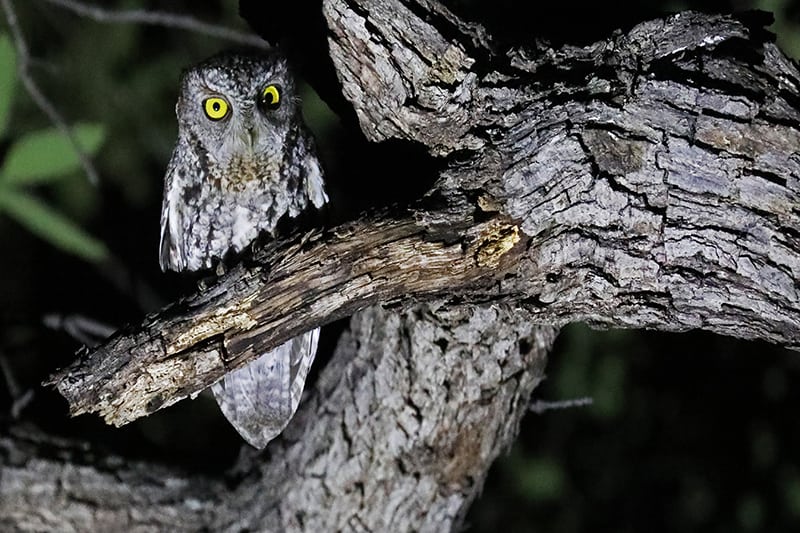
Owl Eyes: The Key to Exceptional Night Vision
Owls have remarkable night vision, primarily due to several distinct adaptations in their eyes.
Adaptations for Low Light Conditions
Owls possess larger eyes in proportion to their body size compared to humans, which allows them to capture more light rays and see better in the dark.
In addition to their large size, owl eyes are more circular and elongated, further enhancing their ability to see in dark conditions.
Tapetum Lucidum
A specialized structure found in the back of owl eyes, known as the tapetum lucidum, acts as a sort of mirror.
This reflects light back through the retina, and subsequently allows for better utilization of the available light.
This enables owls to see effectively at night, even during extremely low light conditions.
Rod Cells and Cone Cells
The retinas of owl eyes are populated with a higher concentration of rod cells than cone cells.
Rod cells are more sensitive to light, allowing owls to detect movement and shapes in dim light, whereas cone cells detect color, which is less crucial for nocturnal visibility.
This high ratio of rod cells is a crucial factor contributing to the exceptional night vision of owls.
Contrary to popular belief, owls are not blind in daylight.
Their pupils have a wide range of adjustment.
This enables the right amount of light to strike the retina, which allows some species of owls to see even better than humans in bright light.
Pupil and Lens Mechanics
Large Pupils and Increased Light Intake
One of the key features that enable owls to have exceptional night vision is their large pupils.
Owls have disproportionately large eyes compared to their body size.
This adaptation allows them to let in more light, which is essential for seeing in low-light conditions.
Furthermore, their pupils have the ability to expand greatly at night, further enhancing their capacity to see in the dark.
Also, they can dilate and contract the pupil of each eye independently, providing them excellent control over how much light hits the retina in each eye.
Flexible Lenses for Improved Focus
Another vital feature of owl eyes is their flexible lenses.
Unlike human eyes, owl eyes are not only larger but also have a different shape, being longer and more circular.
This unique shape allows them to focus on objects at various distances with impressive precision.
Additionally, owls can maintain an excellent depth of field, enabling them to spot and track their prey even when it is moving at high speed.
Moreover, the position in which an owl’s eyes are placed on its head is crucial for its exceptional night vision.
Owls have forward-facing eyes, a characteristic called binocular vision.
This arrangement provides them with a wide range of overlapping fields of view that ensures accurate depth perception.
Role of Skull and Eye Structure
The skull and eye structure in owls play a crucial role in their vision and hunting abilities, allowing them to see in low light and accurately locate prey.
Binocular Vision and Depth Perception
Owls possess an incredible ability to judge depth and distance, thanks to their binocular vision.
Both of their eyes point forward, which allows them to see objects with both eyes simultaneously.
This means they have a field of vision of about 125 degrees, with up to 50 degrees seen with both eyes.
This is essential for accurately estimating the position of their prey.
Humans, on the other hand, have 180 degrees field of vision, of which 120 degrees is seen by both eyes.
The difference in our fields allows us to appreciate just how amazing the owl’s visual capabilities truly are.
Sclerotic Rings for Stability
Unlike humans, owls are unable to move their eyes from side to side. This is why you’ll often see owls bobbing their heads.
Instead, they have specialized bony structures called sclerotic rings that support and hold their eyes in place.
These rings ensure that the owl’s large eyes remain fixed, pointing straight ahead.
The owl’s range of movement may be limited, but this stability allows them to maintain an unwavering focus on their prey, even during the most challenging night hunts.
Hearing and Silent Flight: Complementary Adaptations
These nocturnal predators don’t just rely on their visual acuity; keen hearing and silent flight are crucial adaptations that complement and enhance their predatory prowess.
Owls as Exceptional Listeners
Owls are well-equipped for their nocturnal lifestyle, thanks in part to their highly developed auditory system.
To further enhance their hearing, these birds have specialized features such as asymmetrical ear openings and a prominent facial disc.
This funnels sound towards their ears, like a satellite dish capturing signals.
Owls can open and close their ear conches using muscles situated beneath the feathers around their face.
This ability, along with the exceptional facial disc mentioned above, allows them to better capture and process sounds from their environment.
The Importance of Silent Flight in Hunting
Being able to fly without making a sound is as important to owls’ hunting success as their exceptional hearing.
The “stealthy hunting hypothesis” posits that owls fly silently so their prey remains unaware of their approach, giving their targets less time to escape.
Adaptations in their feather structure enable owls to achieve this silent flight.
These modifications reduce frictional noise and air turbulence while in motion, allowing them to glide through the air unheard by their quarry.
A thorough understanding of this principle could perhaps lead to advancements in areas such as aerodynamics or noise reduction in transportation systems.
Their highly developed hearing, impressive facial structures, and remarkable silent flight are all critical components that contribute to their success as nocturnal predators.
Comparisons with Other Avian Predators
Notable differences arise when comparing the vision of owls with other avian predators, such as eagles, hawks, and falcons.
This is most predominantly in the way these birds have adapted to their respective hunting environments.
Eagles
Eagles, like other diurnal raptors, rely on their keen vision to hunt in daylight.
They have incredible visual acuity, which can be attributed to a high density of cones in their retinas that enables them to spot distant prey in well-lit conditions.
Although they have some degree of night vision, it is not nearly as advanced as that of owls.
Eagles cannot efficiently hunt in low-light situations because their larger eyes are designed to maximize their daylight hunting prowess.
Hawks
Similar to eagles, hawks also belong to the group of diurnal predators.
While their impressive vision is incredibly sharp during daylight hours, they too lack the specialized adaptations that owls possess for night hunting.
Hawks have fewer rod cells in their retinas, which diminishes their ability to see efficiently in low-light environments.
This key difference in retinal structure makes reliance on their daytime hunting abilities a necessity.
Falcons
Falcons, yet another example of diurnal avian predators, mostly hunt during the day.
Their eyes have a similarly high density of cone cells in their retinas, allowing for excellent daytime visual acuity.
These raptors rely more on their speed and agility than their exceptional vision when preying on other birds.
This is because of their particular hunting technique, which involves capturing prey in high-speed aerial pursuits.
Although falcons also possess some degree of night vision, they are not as effective in low-light conditions as owls.
This is due to the absence of retinal adaptations and large, light-collecting eyes that characterize owls.
Owls have a clear advantage over other avian predators, such as eagles, hawks, and falcons.
Their specialized retinas, large eyes, and various other adaptations enable them to thrive in low-light hunting conditions, setting them apart in the world of avian predators.
Daytime Vision and Communication
Although owls are known for their exceptional night vision, their daytime vision should not be overlooked.
They have several adaptations that enable them to see well during daylight hours and communicate effectively with one another.
Color Vision and Cone Cells
While it’s true that owls have more rod cells than cone cells in their retinas, helping them see better at night, it doesn’t mean they completely lack color vision during the day.
In fact, some species of owls can see even better than humans in bright light conditions.
Just like in your own eyes, the cone cells in an owl’s retina allow them to perceive colors, although their color vision may not be as sharp as yours due to the higher ratio of rod cells.
Eyelids and Nictitating Membrane
Another adaptation that aids owls in their daytime vision is their eyelids and nictitating membrane.
They possess a third, semi-transparent eyelid known as the nictitating membrane, which can close to protect the eye and still allow some light to pass through.
This membrane helps owls maintain their vision while keeping their eyes moist and clear of debris, further ensuring their ability to see during the day.
Visual Signals in Owl Communication
Visual signals play an essential role in owl communication, especially during daylight hours, when other nocturnal birds are less active.
Owls can convey important information about their intentions and emotions to other members of their species.
They do this by raising or lowering their ear tufts, changing their posture, or altering the dilation of their pupils.
This form of visual communication is crucial to the owl’s social interactions and can even play a role in mating rituals.
Evolutionary Advantages of Owls’ Night Vision
The owl’s ability to see in the darkness has evolved over time, offering them several evolutionary advantages when it comes to hunting prey and surviving in their environment.
One critical factor contributing to their keen night vision is the presence of a higher number of rod cells in their retinas compared to other birds.
These rod cells increase light sensitivity and allow owls to detect even the slightest movements by their prey.
Although the trade-off is that they lose color vision, owls can spot their target with ease in low-light situations.
Owls’ eyes are also relatively larger compared to other birds which provides them with a wider field of view and superior visual acuity.
Moreover, the tapetum lucidum, a specialized layer of cells behind the retina, helps maximize light absorption and reflection back to the photoreceptor cells.
This further enhances their night vision.
One of the key evolutionary advantages of owls’ incredible night vision is their ability to efficiently hunt nocturnal prey in their surroundings, like rodents and insects.
This edge enables them to exploit resources that other predators cannot access easily, reducing competition and increasing their chances of survival.
Owls’ specific adaptations, from their eyesight to their nocturnal traits like silent flight, have made them successful raptors in the night.
Finally, having evolved excellent night vision also provides owls with an advantage when avoiding predators themselves.
Not many nocturnal animals can spot an owl in the darkness, thanks to their impeccable camouflage and stealth.
This surprising ability contributes to their overall success, allowing them to continue thriving as fascinating nocturnal birds of prey.