
Last updated on September 8th, 2022 at 12:21 am
The Florida Fish and Wildlife Conservation Commission’s Captive Wildlife Office categorizes all animals in captivity into Classes I, II, and III, but they exclude all native birds that are imperiled and prohibited as pets. This means that you might need a license in Florida to have a parrot.
You don’t need a license to own a parrot in Florida because it isn’t classified as a native species nor is it listed as imperiled, prohibited, or conditional. But you need a Class III permit for exhibition and sale. Also, you should abide by the caging requirements.
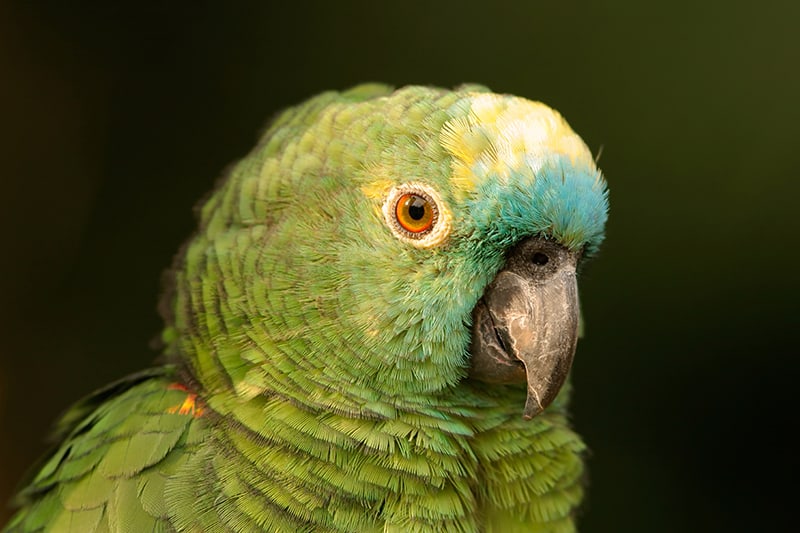
You Don’t Need a License or Permit To Own a Parrot in Florida
Parrots belong to the Superfamily Psittacoidea in the Order Psittaciformes. The smaller family of parrots is called Psittacidae.
This family has more than 350 species and subspecies, including:
- Budgerigar
- Cockatiel
- Macaw
- Parakeet
- Parrots
Parrots, parakeets, and macaws are exotic birds in Florida, grouped in Class III. None of these species or any of the subspecies is native to the state.
In fact, the only parrot that is native to the United States is the red-crowned amazon (Amazona viridigenalis).
Three common names are used interchangeably for the Amazona viridigenalis species:
- Red-crowned amazon
- Red-crowned parrot
- Green-cheeked parrot
The red-crowned parrot was originally native to Mexico, where it’s an endangered species.
The limited range of the species and extensive trapping due to the pet trade has led to an alarming decline of the population of the red-crowned amazon in the wild.
However, the red-crowned parrot, as an introduced and extant species in the United States, has witnessed a population growth, albeit largely in captivity and as pets.
Neither the red-crowned amazon nor any other parrot is recognized as native or non-native in Florida.
That’s why there’s no specific regulation or licensing requirement prohibiting the ownership of these wild birds as pets.
You don’t need a permit or license to own the following wild parrots in Florida:
- Blue-fronted parrot
- Hispaniolan parrot
- Orange-winged parrot
- Red-crowned parrot
- Red-lored parrot
- White-fronted parrot
- Yellow-crowned parrot
- Yellow-headed parrot
- Yellow-naped parrot
Two other distinct species in the Psittacidae or parrot family are budgerigar and cockatiel.
Both birds are popular as caged pets, and you don’t need a license to own one or a few of these in Florida.
You Don’t Need a License To Own Parakeets in Florida
The Psittacidae family also includes parakeets, but most parakeets aren’t on any regulated lists of bird species in Florida.
You can own one or more of the following parakeets without a permit or license:
- Blue-crowned Parakeet
- Canary-winged parakeet
- Dusky-headed parakeet
- Green-cheeked parakeet
- Mitred parakeet
- Orange-fronted parakeet
- Red-masked parakeet
- Rose-ringed parakeet
The black-hooded parakeet and monk parakeet are non-native species of Florida, which you can have as pets without a license.
However, you need a Class III permit if you intend to exhibit these two parakeets or trade the birds.
Also, you need a Class III license or permit to sell a parrot or any of the other birds in its family, such as macaws.
You Do Not Need a License To Own a Macaw in Florida
Blue-and-yellow macaw (Ara ararauna) is the most popular species of its family among bird lovers and avian conservationists in Florida.
It is followed by the chestnut-fronted macaw (Ara Severus).
Both of these macaws are wild parrots introduced to the state. However, neither species is native or non-native to Florida.
There’s no regulation prohibiting the ownership of macaws unless you engage in inhumane trapping and other illegal activities, such as unlicensed trading.
Should you decide to own a parrot, parakeet, or macaw, you must use an identification band for your pet or have a high-resolution photograph for the record.
Take a picture of the facial feathers as they are distinct for parrots and all the other birds in the family.
Having a band or a picture is handy if you have to claim ownership in tricky circumstances.
The exotic parrots and macaws are vulnerable to poaching in Florida.
And although the state prohibits poaching pets from private properties, there’s no law against trapping these birds in the wild.
Florida Has Standard Caging Requirements for Pet Parrots
The Florida Administrative Code and Rules’ Section 68A-6.01215 state the following standard caging requirements for birds, including pet parrots:
- You must provide a perch for perching birds like parrots, parakeets, or macaws. This perch should have a sufficient diameter to prevent the bird’s claws from meeting one another when it is perched.
- Any perch should be high enough so that a parrot’s claws don’t touch the floor or any other structure below. Also, the perching area and the perch itself should be cleaned or replaced periodically for the well-being of your pet parrots.
- The perch and its surrounding area should be spacious enough to accommodate every bird you keep in that place. Otherwise, you must have more perches or cages so that the birds don’t need to use or share the fixtures simultaneously.
- Cages or enclosures should have a perch inside, adhering to the height, size, and material requirements. Also, the space above the perch should be sufficient for a parrot to have optimum head clearance during its normal upright posture.
- The dimensions of a cage or enclosure should be large enough for a parrot to fully extend both its wings. If there are two or more birds in one cage, the dimensions or the perimeter should be increased proportionally.
- A small parrot needs a cage measuring 1-foot x 2 feet x 10 inches (height). Such a cage is sufficient for up to 4 small parrots or parakeets. Every extra bird demands a 25% increase in the size of the cage.
- A mid-sized parakeet or parrot requires a cage measuring 18 inches x 18 inches x 2 feet (height). Every extra bird requires the cage to be 25% larger.
- Larger parrots, especially macaws, require bigger cages. A 2 feet x 2 feet x 3 feet (height) cage may suffice for one large macaw. Adding another bird demands 25% more space in the cage or enclosure. Also, the perch must be longer and sturdier.
This VIVOHome Wrought Iron birdcage (available on Amazon.com) is spacious for a few parakeets or small to medium-sized parrots. The 53-inch tall cage (interior height) comes with the following features:
- 2 large front doors
- 3 solid wood perches
- 4 plastic cups
- A pull-out bottom grille
- Rolling caster wheels
If you need a smaller home for your parrots, consider the Prevue Flight Cage (available on Amazon.com). The interiors are:
- 47 inches high
- 36 inches long
- 22 inches wide
This cage for parrots has all the features of the larger cage. Additionally, there’s a bottom storage shelf.