
Last updated on September 7th, 2022 at 11:52 pm
Birders may be tempted to feed beach birds in California to get closer to the majestic creatures. Many people simply want to feed birds without any specific or strategic birdwatching motive. But this might get you in trouble with the law.
It is illegal to feed beach birds in California. The California Code of Regulations Title 14 Section 251.1 prohibits any kind of harassment of animals, which includes feeding. Also, you shouldn’t disrupt or interfere with the normal behaviors of beach birds in California.
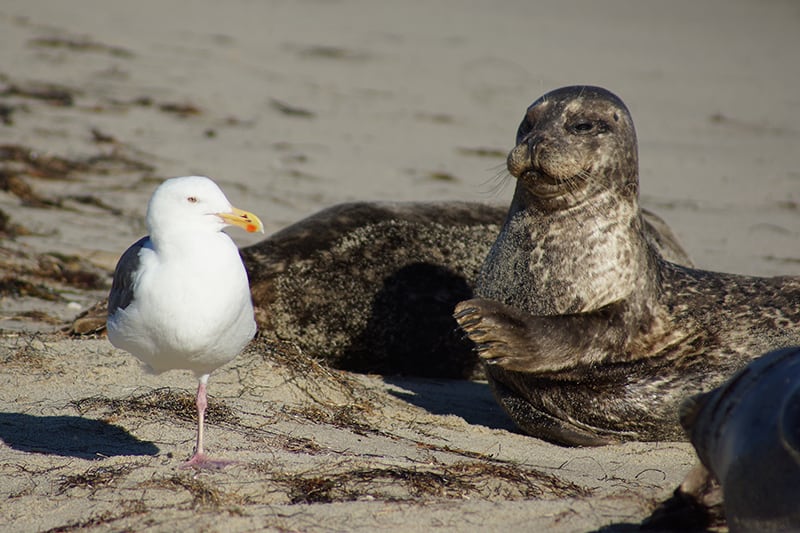
Why It’s Illegal To Feed Beach Birds in California
The California Code of Regulations Title 14 has 25 divisions and 5,595 sections, not all of which are about beach birds.
There are many prohibitions and some exemptions, but the latter doesn’t have much leeway for feeding.
However, consult an attorney if you have any specific questions about this topic.
The specific laws about harassment of beach birds or wild animals, in general, cover:
- Breeding
- Feeding
- Sheltering
Many beach birds breed on the sandy or rocky shores of California.
Some species of beach birds depend on the vegetated dunes to nest, breed, and roost.
This means that feeding beach birds in California may disrupt their breeding and sheltering habits.
You may consider the possibility that feeding beach birds won’t affect their breeding, and the action won’t amount to sheltering.
However, there are several other concerns that are the foundation of the California Code of Regulations Title 14.
Here are a few indisputable reasons:
- Disease: Beach birds are vulnerable to disease if the offered food is contaminated. This risk applies to wildlife, in general, but it’s vital for birds as they aren’t as sturdy and immune as some of the other animals.
- Nutrition: Birds don’t obtain much nutrition from bread, fries, or other human foods. They need nutritious natural foods for crude protein, fat, and minerals, among other micronutrients. Most beach birds won’t benefit from the foods that people consume.
- Habituation: One of the main reasons for the stringent California law is the objective of preventing wildlife from getting habituated with food that would otherwise be unavailable in nature. This habituation threatens the survival of beach birds and other wildlife.
- Natural skills: Beach birds habituated with food provided by people may stop wading or foraging for their staples in the wild. This behavioral change can affect the natural skills of wild birds, irrespective of habitat and nutritional requirements.
- Migration: Several beach birds migrate due to climate, availability of food, and breeding compulsions. Disrupting their natural behavioral patterns and influencing basic needs may alter the migratory tendencies of many species.
- Nuisance: Beach birds habituated to being fed by people can learn to associate humans with a food source. Thus, beach birds may lose their fear of people and approach them for food. This consequence is essentially changing the natural behavior of beach birds.
- Ecosystem: Beach birds, whether they are resident or migratory, play a significant role in their ecosystem. Any substantial change in their behavior, from foraging to breeding, can affect the coastal ecosystem, including other wildlife.
- Population: Most bird species breed in ideal conditions, including climate, nesting, and food availability. Feeding beach birds in California may influence some species to breed and reproduce more due to the artificial availability of excess food.
Beach Birds You Cannot Legally Feed in California
It is illegal to feed the following beach birds in California:
- American crow
- Anna’s hummingbird
- American pipit
- American white pelican
- Black-bellied plover
- Black oystercatcher
- Black phoebe
- Black turnstone
- Brandt’s cormorant
- Brewer’s blackbird
- Brown Pelican
- California gull
- Canada goose
- Caspian tern
- Common loon
- Common murre
- Common raven
- Dunlin
- Elegant tern
- Forster’s tern
- Glaucous-winged gull
- Heerman’s gull
- Horned lark
- House finch
- Killdeer
- Least sandpiper
- Least tern
- Long-billed curlew
- Marbled godwit
- Merlin
- Northern harrier
- Peregrine falcon
- Ring-billed gull
- Royal tern
- Ruddy turnstone
- Sanderling
- Say’s Phoebe
- Semipalmated plover
- Snowy plover
- Spotted sandpiper
- Surf scoter
- Surfbird
- Turkey vulture
- Wandering tattler
- Whimbrel
- Willet
- Western grebe
- Western gull
- Western meadowlark
- Western sandpiper
Is It Illegal To Feed Backyard Birds in California?
It’s illegal to feed backyard birds in California if your practice alters the natural behavior of any wild species.
Also, you cannot attract other wildlife, such as games and other mammals.
However, feeding garden or backyard birds is in a legal gray zone because the statewide code or the local laws aren’t enforced strictly.
The worst scenario for you might be a misdemeanor charge.
Can You Have Bird Feeders in California?
You can have bird feeders in California unless your local law states that such installations are illegal.
The statewide code has a few exemptions that may or may not apply to you, so these enforcements are almost always subjective.
For instance, the California Code of Regulations Title 14 exempts landowners and tenants that herd or drive away birds and other animals to protect their private property.
Such actions are not tantamount to harassment of wildlife, whether backyard or beach birds.
If you were to use a bird feeder in California to isolate the nuisance caused by the feathered creatures, the state law wouldn’t even charge you with a misdemeanor.
However, you should be aware of any bylaws of your property or homeowners’ association.
Bird Feeders in California Must Not Attract Other Wildlife
Irrespective of the variables that may apply to your case, your bird feeder in California must not attract other wildlife.
If you load a bird feeder with seeds, nuts, or a mix, the feeder must not make a large mess that may attract other animals, such as deer.
Many homeowners’ associations restrict the use of bird feeders so that the spilled material does not attract rodents and other critters.
Likewise, suet is a risky proposition if you live in any part of California that has a bear problem.
If your backyard feeders in California draw deer, bear, or other wildlife, apart from the birds, you will provide more than sufficient reason for the local enforcement departments to act.
That said, you can restrict the mess with feeds like Lyric’s Fine Tunes No Waste Mix (available on Amazon.com).
This 5-pound bag of bird seed mix has the following ingredients without hulls, shells, or fillers:
- Almond pieces
- Peanuts pieces
- Pistachio pieces
- Sunflower kernels
- Hulled white proso millet
- Shelled pumpkin seed pieces
Such mixes in backyard feeders are likely to attract some of the most popular garden birds in California, including but not limited to the following:
- California scrub-jay
- California towhee
- Chestnut-backed chickadee
- Dark-eyed junco
- Oak titmouse