
There are around 350 species of hummingbirds in the Americas, but just over a dozen are found in the United States. Only 3 of these species are found in Florida, and since they are migratory, are hummingbirds in Florida all year round?
Hummingbirds are not in Florida all year round, except for the ruby-throated hummingbirds that may stay put in the winter. Black-chinned and rufous hummingbirds may visit Florida in the fall and winter as they migrate to Mexico and often farther south into the tropics.
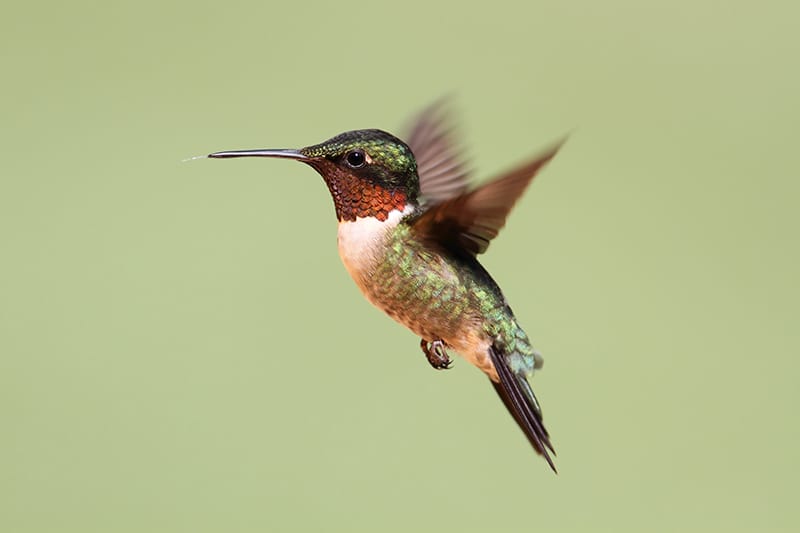
Ruby-Throated Hummingbirds Are in Florida All Year Round
The most common hummingbird species east of the Great Plains is the ruby-throated hummingbird (Archilochus colubris).
This is the most abundant species in Florida, and it’s the only one that’s likely to stay in the state all year round.
However, you may not find this bird everywhere in the state during winter because it migrates to the warmer tropics.
Some ruby-throated hummingbirds may spend their winters in south Florida, while others fly to Mexico and sometimes farther south to Panama.
The ruby-throated hummingbird is the only species that breeds in Florida, among other states.
Ruby-Throated Hummingbirds Breed in Florida
Here’s a timeline of the breeding pattern of ruby-throated hummingbirds in Florida:
- The ruby-throated hummingbirds that stay in Florida all year round begin nesting in April.
- Those migrating southward for the winter return to Florida in February through March.
- The males usually arrive before the females, with a gap of around 1 week to 10 days.
- The females build the nest and lay and incubate the eggs over a period of 15 to 20 days.
- The young ruby-throated hummingbirds grow for around 4 weeks before their first flight.
- Neither the adults nor the young hummingbirds growing in Florida migrate until winter.
- While ruby-throated hummingbirds do migrate, many stay in Florida throughout the year.
Therefore, you’ll find ruby-throated hummingbirds in Florida from late February or early March through November.
If you’re in south Florida, you may also find them from December to February.
However, South Florida is not the most favored breeding region for the species, although nests and other evidence of broods have been found in every county of the state.
Ruby-throated hummingbirds have the largest breeding range among all the species found in the U.S. They breed across almost half of the country, covering:
- Most eastern states, including the northeast.
- Many midwestern states, including Kansas.
- Much of the north up to Saskatchewan in Canada.
Despite such an enormous breeding presence, ruby-throated hummingbirds are most likely to be found all year round only in Florida.
Those that breed north of central Florida must migrate south in the fall and stay closer to or in the tropics throughout the winter every year.
Where To Find Ruby-Throated Hummingbirds in Florida
Here’s a list of the natural habitats where you can find ruby-throated hummingbirds in Florida:
- Open woods
- Hardwood forests
- Agricultural lands
- Stream floodplains
- Gardens and parks
- Suburban areas
In winter, you will likely find ruby throats in open areas, such as dry scrubs and shrubs.
Those migrating to and from Florida are drawn to open habitats, especially parks and gardens with several flowers.
These tiny birds require a lot of energy, especially fat reserves, to fuel their seasonal migration, which is often over 1,000 miles in a single flight.
The ruby-throats need to gorge on nectar and insects, usually doubling their body mass in the process, to survive the long and tedious flights.
Thus, anything en route to and from their breeding range or along the flights during migration providing the necessary food will likely entice the ruby-throats to stop by.
How To Attract Ruby-Throated Hummingbirds in Florida
The staple food of hummingbirds is nectar.
Adult ruby-throats feed insects to their hatchlings, but the hummingbirds switch to nectar shortly after their first flight.
Nectar is the only food that provides them with the energy they need.
Hence, the ruby-throats are attracted to abundant nectar sources, including the following:
- Trees
- Shrubs
- Vines
- Perennials
- Annuals
In Florida, the most effective plants to attract ruby-throated hummingbirds are:
- Bottlebrush
- Butterfly bush
- Coral bean
- Firebush
- Red star hibiscus
- Firespike
- Wild azalea
- Cross vine
- Trumpet vine
- Coral honeysuckle
- Butterfly milkweed
- Red basil
- Shrimp plant
- Cardinal flower
- Obedient plant
- Scarlet morning glory
- Cypress vine
- Standing cypress
Plants like bottlebrush are a failsafe way to attract ruby-throated hummingbirds in Florida.
Since many of these plants are native to the state, growing or sustaining them through their blooming season should be simple.
Many birders and enthusiasts use sugar solutions in feeders to attract hummingbirds.
While the ruby-throats are drawn to the sweetness of sugar water, such solutions don’t have any nutrients that these birds need and get from nectar.
Thus, native and other flowers are a better way to attract hummingbirds. Ruby-throats gravitate towards innumerable bright and colorful flowers.
Besides, every ruby-throat needs nectar from hundreds of blossoms, so they aren’t too picky about the type of flower or plant.
Migrating Hummingbirds in Florida Through Fall and Winter
Black-chinned and rufous hummingbirds are the two migrating species usually found in Florida towards the end of the rainy season.
And may stay in the state through autumn or fall.
Some may spend their winters in Florida, but most will fly to Mexico and Central America.
Buff-bellied hummingbirds are occasionally seen in northwest Florida, while other species make rare appearances, if at all.
Sighting these migrating hummingbirds in Florida isn’t predictable, and a few species have undergone a population decline in recent decades.
While ruby-throated and black-chinned hummingbirds have a relatively stable population, rufous has witnessed a significant decline in its population over the last five decades.
Even black-chinned and ruby-throated hummingbirds had a negative population trend between 2009 and 2019.
Allen’s hummingbird has fared the worst among all the surveyed species, but it wasn’t typically sighted in Florida.
Anna’s hummingbird is the only species with promising population growth in both long and short-term studies.
However, Anna’s hummingbird breeds along the Pacific coast and doesn’t migrate eastward to the plains.
Spotting this species in Florida is a nonstarter unless it changes its habitat or migratory behavior.