
Last updated on August 25th, 2022 at 12:30 am
Released in 1996, the family drama movie Fly Away Home tells the story of a 13-year-old girl who finds an abandoned nest of Canadian goslings. She both raises and then later trains them to fly using a custom-built ultralight aircraft.
Some of the scenes were developed with the help of computer graphics, but what about the scenes where the geese are following the main character?
They got the geese to follow in Fly Away Home by training the geese intensively, using a stand-in and voice recordings of actor Anna Paquin when she was not available. By encouraging the geese to trust her, they activated their natural following instincts and taught them to respond to cues.
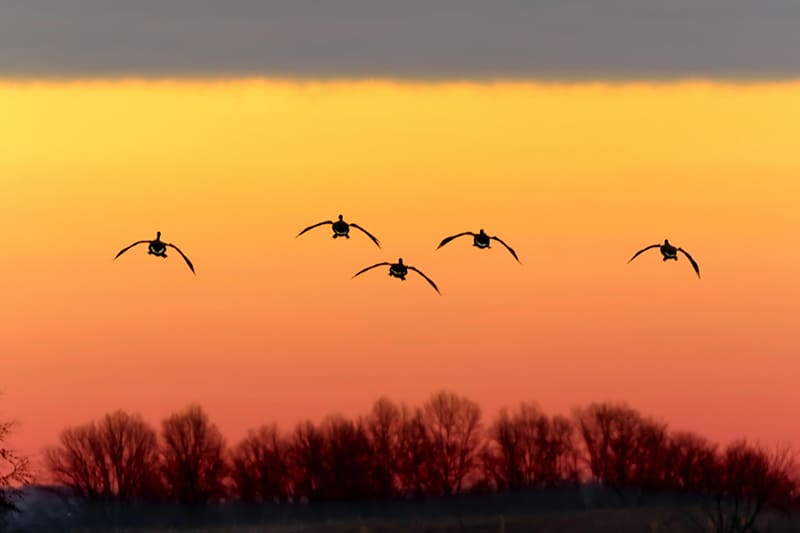
This Is How They Got the Geese To Follow In Fly Away Home
One of the great achievements of Fly Away Home is how the filmmakers were able to capture such beautiful cinematography.
Some of the visually stunning scenes include Lake Ontario, the misty towers of Baltimore, and of Amy (Anna Paquin) leading the geese in training.
Are the Geese in Fly Away Home Real?
The geese in Fly Away Home are real in many scenes, but some use computer-generated graphics and models of geese.
This allowed the creators of the movie to film scenes like the one where Igor runs into Amy’s glider.
And also, the one where Amy touches the goose leading the flock in the air.
How Were the Geese Trained For Fly Away Home?
The geese were trained for Fly Away Home by professional animal handlers with recordings of Paquin’s voice.
This assisted in the training of the birds to recognize and follow her.
With time the geese bonded with the actress and learned to follow her and perform in response to cues.
Several Canadian humane organizations and Operation Migration were involved in the making of the film.
They ensured that the training process was fair to the animals and not harmful.
Were Animatronic Geese Used In Fly Away Home?
Animatronic geese were not used in Fly Away Home. However, the movie did rely upon some computer-generated graphics and fake, non-robotic geese.
Many of the scenes involving geese were filmed with real, live animals who were trained to perform on set.
Is Fly Away Home Based On a True Story?
Fly Away Home is based on a true story.
A decade before the movie was made, a man named Bill Lishman attempted to raise and train a flock of birds, much like the protagonist does in the movie.
Director Carroll Ballard adapted this story with a child as the lead in her retelling of his adventures.
Bill Lishman, the man on which the story is based, was a sculptor and a father of three.
He was largely successful in his attempts to teach Canadian geese to follow him.
For three years, he worked with a single flock of geese to get them to imprint on him and his vehicles, getting them comfortable with him and the sound of an engine.
Lishman’s first flight with the birds took place in South Carolina in 1988, eight years before Fly Away Home was released.
He successfully led a V-formation of 12 birds a short distance in his hometown in Ontario, Canada.
Five years later, he would lead 36 geese in a V-formation all the way down to South Carolina in the United States.
Lishman wrote about his adventures flying with geese in his autobiography, Father Goose: One Man, a Gaggle of Geese, and Their Real Life Incredible Journey South (available on Amazon.com).
This autobiography was ultimately the work that inspired filmmakers to adapt the story.
Why Do Geese Follow a Leader When They Fly?
Geese follow a leader when they fly because it optimizes lift and reduces drag.
Their V formation, also known as an echelon, is aerodynamically efficient for the majority of the group.
Despite the fact that the birds at the front face the brunt of the wind and do not see an advantage.
How Geese Decide Who To Follow
Geese typically do not follow the same bird all the time when they are flying.
Unlike in Fly Away Home, they rotate which bird is out front while they’re migrating so that no bird grows too weary from taking on the extra resistance.
They don’t recognize a flying leader or prioritize leaders based on strength or hierarchy.
In the extraordinary case of Bill Lishman, the geese acted outside of their natural behavior because they were trained to respond a certain way to him and his equipment.
They followed him for the entire flight from Canada to South Carolina, perhaps because he confidently kept his spot in the lead rather than ducking back to allow another goose to take control.
Can You Train Canadian Geese?
You can train Canadian geese, but it is illegal to take them, or their eggs into captivity like Amy did in Fly Away Home unless you have a special government-issued permit.
So, you cannot collect geese and train them at home, nor can you incentivize them with any actions that might harm them.
Canadian geese are protected by the Migratory Bird Treaty Act, an agreement between the United States, Canada, Mexico, Japan, and formerly the Soviet Union.
Under this act, no person can take a migratory bird native to North America into captivity, nor can they trade them or alter their nests or eggs.
Hunting is allowed only within specific guidelines.
Can You Raise Wild Birds In Captivity?
You cannot raise wild birds in captivity unless you have a special permit to do so in North America.
There are exceptions for invasive or other non-native species, but even in these cases, it’s risky to attempt to take in a wild animal and raise it domestically.
Generally, the best way to bond with wild birds is to visit a bird rescue or other animal sanctuary where birds are taken in for rehabilitation.
Volunteering at such a facility is a great way to learn the necessary skills to truly take good care of wild birds and do good rather than harm.
Each state offers its own wildlife rehabilitation training programs.
You can learn more about the programs available in your area through the National Wildlife Rehabilitators Association website.