
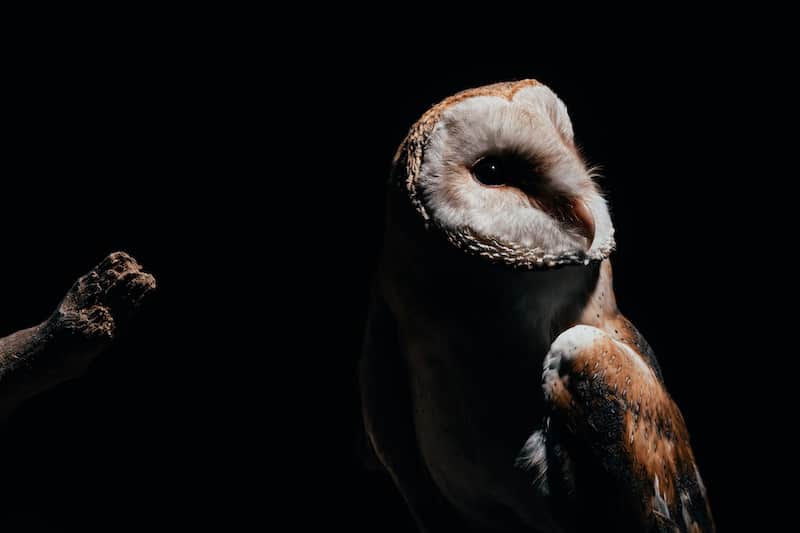
An owl’s head turns with such graceful ease as it scans the sky and takes to flight. How far can these transient beings turn their heads?
Birds can turn their heads to varying degrees depending on the species. This capability allows them to maintain a broad field of vision, vital for survival in their environment. Some birds, such as owls, can rotate their heads by up to almost 270°, while others rely more on sideways vision for acute perception.
Anatomy of Bird Necks
Cervical Vertebrae
Birds possess a unique neck anatomy that allows them impressive flexibility.
Their cervical vertebrae vary in number, ranging from 11 in hummingbirds to 25 in swans.
This wide range of vertebrae grants birds a remarkable ability to turn their heads.
Flexible Necks
Brevity lies in the explanation of the neck’s flexibility: the makeup of the vertebrae themselves.
Birds have saddle-shaped joints that increase the range of motion in their necks.
This flexibility allows birds like eagles and hawks to scan the horizon for prey or keep a keen eye on their surroundings.
One study found that birds are even able to isolate their head movements while flying, employing their flexible necks as dampening mechanisms.
Unique Vascular Structure
The success of these head-turning feats depends not only on vertebrae but also the vascular structure.
In a bird’s neck, a vertebral artery and an intricate network of blood vessels supply oxygen-rich blood to the head.
This unique vascular arrangement permits a bird to rotate its head without occlusion or damage to the blood vessels—even when twisting up to 270°.
Vision and Head Movements
Field of Vision
Birds possess a wide field of vision, essential for detecting threats and locating prey.
Their eyes are positioned on the sides of their heads, allowing for up to 270° coverage before potential damage.
To achieve optimal sight, they turn their heads, often swiftly and accurately.
With eyes on the sides, they use their head movements to gain depth perception.
In-flight birds may turn their heads in both pitch and yaw, making it easier to detect and focus on their surroundings. The deep fovea adds to their sharp vision.
Binocular Vision
Although birds have extensive peripheral vision, their binocular vision is limited.
To see objects with greater clarity, they move their heads to align objects within their binocular field of view.
Birds do have eye movements, but their primary function is to hold their heads and eyes still so they can better see movement.
Their eyeballs are fixed due to the rigid sclerotic ring, thus requiring head turns for acute perception.
Head movements differ among species, with some birds exhibiting complex patterns to maximize their visual information.
Night Vision
Night vision in birds is a crucial adaptation for nocturnal species, such as the tawny owl.
These birds have larger eyes relative to their size, which allows for greater light-gathering capacity.
Additionally, their retinas have a high concentration of rod cells, aiding in low-light vision.
While night vision in some birds is efficient, it is not as fine-tuned as in animals such as cats.
Birds still rely on head movements and wide visual fields to maximize their delicate night sight.
This aids in keeping watch for both prey and predators under the cover of darkness.
Birds with Remarkable Neck Flexibility
Owls
Owls possess a unique neck structure, enabling them to turn their heads more than 270° in either direction.
They rely on such flexibility to compensate for fixed eye position. This allows for an uninterrupted field of vision while their body remains stationary.
The Great Horned Owl exemplifies this dexterity among owl species.
Hawks
Hawks exhibit great neck dexterity, making rapid head movements to track their surroundings effectively.
Their ability to quickly change head angles assists in sudden aerial maneuvers, crucial for hunting purposes.
Eagles
Eagles’ necks showcase flexibility in head positioning, as observed primarily during flight.
Their strong neck muscles help maintain stability and provide the required dexterity for soaring and hunting at significant altitudes.
Falcons
Falcons, like other birds of prey, depend on their exceptional neck movement to enhance their vision and hunting prowess.
Their neck muscles support swift head rotations, allowing them to scan the surroundings without interrupting their flight path.
Adaptations for Head Rotation
Arterial Reservoirs
Birds have evolved unique adaptations to facilitate head rotation, such as arterial reservoirs.
These reservoirs assist in maintaining blood flow to the brain during extreme head rotations.
The vertebral artery, which supplies blood to the brain, is specially designed to prevent blood clots and to maintain uninterrupted blood flow.
Tiny reservoirs located along this artery store blood and release it when necessary, ensuring a steady flow of oxygen and nutrients to the brain.
Air Pockets and Cushions
Another adaptation related to head rotation in birds are air pockets and cushions.
These provide extra support during the twisting and maneuvering of the head.
The air-filled spaces help protect delicate blood vessels during rapid head movements, giving the bird additional stability and flexibility.
Intact birds use visual cues to gauge distances when climbing, cancelling out head rotations for stabilization.
These air pockets and cushions work in tandem with other adaptations.
This includes a specially designed bone structure, to provide the bird with the ability to execute swift and precise head rotations.
Specially Designed Bone Structure
Birds possess a unique bone and vascular structure that allows for ample head rotation.
For example, barn owls can rotate their heads to 270° due to the combination of yawing and rolling movements in the neck region.
This adaption is an integral part of their hunting strategy, enabling them to effectively track and target prey.
In addition to the specialized bone and vascular structure, birds exhibit a deep fovea.
This allows them to possess sideways vision while maintaining acute focus when looking straight ahead.
It is achieved by turning their heads sideways or rotating them in various directions while maintaining high levels of visual acuity.
Scientific Research and Studies
Medical Imaging
Scientists employed CT scans to study bird necks and understand their range of motion.
They discovered that birds possess a unique neck structure, with more cervical vertebrae than mammals.
This allows them a greater degree of rotation in their necks.
Johns Hopkins University School of Medicine Research
Researchers at Johns Hopkins University School of Medicine dove deeper into the topic.
They analyzed bird movements like head tilt and yaw to identify potential limitations in their visual field.
They learned that birds lack the ability to turn their eyes much in the sockets, which makes them dependent on head movements for their vision.
Popular Misconceptions and Dramatic Feats
One common misconception is that birds can turn their heads in full 360° due to their spherical-shaped eyes.
In reality, each bird species holds unique head movement capabilities.
Birds possess a wide range of head movement, sometimes turning their heads as much as 270°.
This ability compensates for having fixed eyes that move only slightly in their sockets.
They rely on their flexible necks to scan their surroundings and stay vigilant.
- Owls: Renowned for their head-turning abilities, they can rotate their heads up to 270° left or right.
- Pigeons: Their heads can swivel as much as 180° in both directions, gracefully keeping an eye on their surroundings.
- Flamingos: With their long, flexible necks, they can turn their heads almost 180°, enabling them to preen difficult-to-reach body areas.
Owls have evolved to perform silent flights, a dramatic feat crucial for their hunting success.
Their feathers have soft, comb-like edges that reduce noise by breaking up turbulence created during flight.
This stealthy approach allows them to get closer to their prey without detection.