
Within the realm of bird behavior exists a dark truth: the theft of eggs amongst avian species. Do birds really steal eggs from others?
Among bird species, the act of stealing other birds’ eggs is not uncommon. Some, known as brood parasites, deceive their hosts, replacing their eggs with their own in the nest. Others pilfer eggs as a food source, driven to survive in nature’s wild dance.
Birds That Steal Eggs
Cuckoos
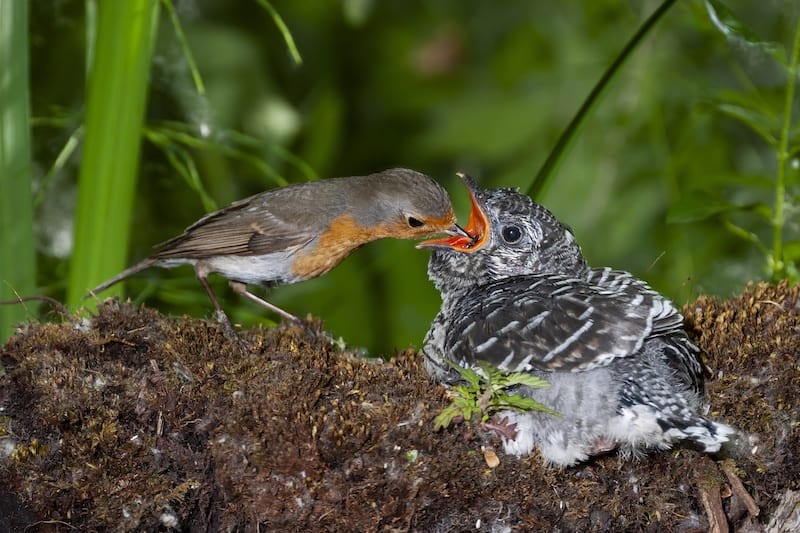
Cuckoos are notorious for their egg-stealing behavior.
The common cuckoo, for example, practices brood parasitism, laying its eggs in the nests of other bird species.
These unsuspecting hosts then incubate and care for the cuckoo’s offspring.
When the cuckoo hatchling emerges, it often removes the host’s eggs or nestlings to secure more resources for itself.
Cowbirds
Brown-Headed Cowbirds, similar to cuckoos, are brood parasites.
They lay their eggs in the nests of other birds, shifting parental responsibility to their unsuspecting hosts.
The cowbird eggs often hatch earlier than the host’s eggs, leading to host parents focusing on feeding cowbird chicks while their own offspring face starvation.
Corvids
Corvids, a bird family that includes crows, magpies, jays, and ravens, are known for their intelligence and adaptable nature.
Some members of this group, such as the Jackdaw, have been observed stealing eggs from other birds’ nests.
Crows and magpies are more opportunistic in their approach. They tend to steal eggs when nests are left unguarded or when observing host birds away from the nest.
Ravens, due to their larger size, have been known to take not only eggs but also nestlings as part of their diet.
While Starlings are not actually corvids, they are also known for their egg-stealing behavior.
Starlings have been observed stealing eggs from other birds’ nests, often using their sharp beaks to puncture the eggs and then carrying them away in their beaks.
Why Birds Steal Eggs
Brood Parasitism
Some birds steal eggs as a result of brood parasitism. This behavior occurs when a bird lays its eggs in another bird’s nest.
The host bird unknowingly incubates and raises the parasite’s offspring. The benefits are clear: no energy spent on building nests or raising their own young.
Cowbirds and cuckoos are notorious brood parasites.
In this system, the parasite’s eggs often resemble the host species’ eggs. This deception increases the chances of the host caring for the intruder’s offspring.
Sometimes, the brood parasite’s offspring outcompete the host’s chicks for resources or even push host’s eggs out of the nest to secure all available resources for itself.
Food Source
Egg stealing can be driven by the need for food. Eggs contain essential nutrients like proteins, fats, and vitamins, fulfilling a predatory bird’s dietary needs.
Smaller birds often face higher risks since predators can quickly rob them of their eggs.
Predators:
- Crows and ravens
- Jays and magpies
- Snakes
- Raccoons
- Squirrels
Not only do predators take eggs for nourishment, but birds of the same species might also steal eggs to feed their offspring or gain energy to lay their eggs.
This practice can also result from failed breeding attempts or a desire to reduce competition for resources.
Host Species and Their Adaptations
Recognizing Parasite Eggs
Host species like songbirds, robins, and warblers have made attempts to evolve and adapt to the threat of parasitic birds stealing their eggs.
One key adaptation has been the ability to recognize parasite eggs in their nests.
This helps in identifying foreign eggs, enabling them to remove or abandon such eggs.
Eggshell color and pattern variations have evolved, making it more challenging for parasites like cuckoos to successfully lay their eggs unnoticed.
Dunnocks, pipits, and wagtails have also developed their egg recognition abilities.
Some hosts even use the egg size, shape, or markings as a way of identifying their own eggs.
Defensive Strategies
As a response to brood parasitism, several host species have developed defensive strategies for protecting their nests and eggs.
Gulls, owls, pheasants, and partridges commonly rely on aggressive behavior for nest defense, putting up a strong fight against intruding parasitic birds.
Among other host species, nest concealment has become a vital adaptation.
Hiding nests in dense foliage or hard-to-reach locations can deter parasitic birds from discovering and accessing them.
Some host species, like zoological birds, synchronize their breeding seasons to make it more difficult for parasites to take advantage of abandoned nests.
This limits the opportunities for parasitic birds to lay eggs in their nests without being noticed.
Effects on Populations and Ecosystems
Birds, including Crows and other corvids, steal eggs from other birds’ nests and consume them.
In some cases, this thievery leads to decline in avian populations.
Chicks and baby birds are taken and consumed by these egg robbers, particularly in Asia and North America.
There are other predators – rats, stoats, foxes – that also prey on birds’ eggs and contribute to the aforementioned population issues.
These animals are known to affect nesting success, which in turn has consequences on the overall health of the ecosystem.
Common cuckoos, however, present a different type of egg thievery.
They lay their eggs in the nests of other bird species, and when their chicks hatch, they push the host’s eggs out of the nest.
This parasitism has a negative impact on the host species’ population.
Apart from egg predation, climate change also affects the competitive relationships between resident and migratory birds.
This has an impact on populations and ecosystems.
Variable incubation temperatures likewise affect bird species’ success, as observed in megapodes and waterfowl.
Their incubation temperature has significant effects on hatching success and overall population numbers.
Unusual Cases and Interesting Facts
Blue jays are notorious for preying on eggs and nestlings. These agile birds can swiftly drive a parent bird from its nest and consume or seize its eggs.
The fly, an unconventional predator, targets the outer shell of an egg. It lays its eggs near, if not on, the bird’s eggs.
The eggs develop into voracious larvae that eventually eat away at the bird’s egg.
Cuckoo chicks exhibit a ruthless behavior. They hatch earlier than their foster siblings and remove any other eggs from the nest.
The cuckoo chick thus monopolizes the parent birds’ attention and resources for itself. A similar behavior can be observed in cowbird eggs.
When placed in a nest with American Robins, cowbird eggs hatch earlier and demand more resources from the parent robins, often to the detriment of the native chicks.
Indigobirds and whydahs take a more subtle approach. These birds mimic the appearance and song of their chosen host species.
This cunning masquerade allows them to deposit their eggs in the host’s nest without raising alarm.
The foster parents raise the Indigobirds or Whydahs as their own, often unaware of the deception.
Hummingbirds, known for their beauty and swift flight, have been observed stealing other hummingbird’s nectar.
While it’s not a case of egg theft, it highlights that even birds as delightful as hummingbirds can display unfavorable behaviors.
Ornithologists have probed these behaviors for years, attempting to unveil the strategies and motives behind them.
It’s worth noting that laws have been enacted to protect birds and their nests.
The Migratory Bird Treaty Act, for instance, prohibits capturing, killing, or tampering with native bird species, including their nests and eggs.
Egg stealing among birds showcases the complexities and intricacies of wildlife behavior.
Each species tries to survive and reproduce, sometimes resorting to borderline nefarious methods. The birds’ world is much more complicated than it seems.