
The quantity and frequency of egg-laying varies significantly amongst bird species. It is greatly influenced by factors such as food availability and nesting conditions.
Most birds lay between one and ten eggs at a time, with the average being around four to five. Hummingbirds lay only one or two eggs at a time, while ostriches can lay up to 100 eggs in a year. It is determined by many factors, including the bird’s size, its habitat, and breeding habits.
Determinants of Bird Egg Laying
Species
Species play a significant role in determining how many eggs a bird lays at a time. Different bird species lay varying numbers of eggs per clutch.
For instance, some species can lay just one or two eggs, while others can produce over a dozen.
This variation is often related to the size of the bird, habitat, and survival rate of offspring.
Age
The age of the bird influences its egg-laying capacity. Young birds typically lay fewer eggs compared to mature ones that have reached their prime reproduction age.
As birds age further, they might experience a decline in egg production.
The relationship between laying date and egg size to female age has been explored in various studies, shedding light on this age-related trend.
Environment
Environmental factors also impact the number of eggs laid by birds.
The availability of food, nesting sites, and climate conditions can all affect a bird’s decision to lay eggs.
Birds are more likely to lay eggs when food is abundant and nesting conditions are favorable.
Changes in temperature or the presence of predators may alter the egg-laying process.
Adaptive variations in a bird’s laying date have been found to be determined by a single response mechanism related to environmental factors.
Health
The health of a bird is critical for egg production. Healthy birds can invest more energy and resources into their reproduction.
Unhealthy birds may not have the same capacity, leading to a reduced number of eggs or lower quality of offspring.
Maintaining good health is vital for birds to optimize their reproductive success.
Birds and Their Clutches
Clutch Size Variation
Birds lay different numbers of eggs depending on their species. Some lay just one egg, while others can lay over a dozen in a single clutch.
Factors impacting clutch size include environmental conditions, food availability, and predation risk.
Clutch size variation in passerine birds, for example, has been linked to nest predation risk, influencing the number of eggs a bird can safely lay at a time.
Nesting and Incubation Periods
Nesting refers to the period when birds build their nests and prepare to lay their eggs.
The incubation period begins when the parent birds take turns sitting on their eggs, keeping them warm and safe until they hatch.
Incubation times vary greatly among different bird species, ranging from 11 days for the African village weaverbird to more than 50 days for large birds like albatrosses.
| Species | Incubation Period (Days) |
|---|---|
| African village weaverbird | 11 |
| Great tit | 12-15 |
| Albatross | >50 |
Single Egg Layers
Some species of birds, such as the kiwi, lay only one egg per breeding season.
Laying a single egg can be advantageous and energy-efficient, as the bird can focus its efforts on raising just one offspring.
This allows the parent bird to provide more attention and resources to its single egg, increasing the likelihood of its survival.
Breeding Seasons and Bird Egg Laying
Mating Rituals and Nest Building
Birds invest time in mating rituals to attract a suitable partner. These rituals vary across species and involve displays of plumage, song, or dance.
Once the partner is chosen, they embark on nest building.
Nests provide a safe and warm environment for eggs and nestlings. Bird nests vary in materials and design, demonstrating the ingenuity of these creatures.
Some birds use sticks, grass, or leaves, while others employ mud, feathers, or spiderwebs in their construction.
Effect of Latitude and Climate on Bird Breeding
Latitude and climate have a direct impact on bird breeding seasons.
Birds in temperate regions lay their eggs mostly in spring and early summer when food is abundant.
However, tropical birds breed year-round, although their egg-laying is often concentrated in specific months.
In general, birds at higher latitudes have shorter breeding seasons due to colder climates.
While those closest to the equator have more flexible and extended breeding periods.
The availability of food resources plays a key role in determining the timing of egg-laying.
When climate conditions favor an abundance of food, birds can produce more offspring, increasing their chances of survival.
Temperature and rainfall also influence egg-laying. As temperatures rise, birds in colder regions might lay their eggs earlier, as seen in the kittiwake gull.
Meanwhile, African land birds experience more defined breeding seasons aligned with wetter months, when food is plentiful.
Egg-laying frequency and quantity depend on the bird species and environmental conditions.
Breeding seasons are shaped by mating rituals, nest building, latitude, and climate.
Common North American Birds and Their Egg-Laying Patterns
American Robin
The American Robin (Turdus migratorius) is a familiar bird across North America. They lay 3-5 eggs at a time, with a blue color and an oval shape.
These eggs hatch in about two weeks, and the young birds leave the nest in about the same time frame.
Robins may produce up to three broods each season, giving them an advantage in terms of population growth.
Northern Cardinal
Similarly, the Northern Cardinal (Cardinalis cardinalis) is another common bird in the continent.
These birds lay 2-5 eggs, with a white to pale greenish-blue color, adorned with brown and purple spots.
The incubation period lasts for about 11-13 days, and the young fledge in under two weeks.
Cardinals might raise up to three broods in a single season, which aids in maintaining their population.
Mallard
The Mallard (Anas platyrhynchos) is a widespread waterfowl species in North America. These ducks commonly lay 8-13 eggs, which possess a greenish color.
The incubation process takes about 23-30 days, and fledging occurs after 50-60 days.
Mallards have a single annual breeding season, laying eggs from late winter to early spring.
Great Blue Heron
The Great Blue Heron (Ardea herodias) is one of the common wading birds present in the region.
These graceful birds lay 3-6 bluish-green eggs in their nests, which take around 27-29 days to incubate.
The fledgling stage lasts for about 60 days, during which the young birds learn to fly and hunt.
Great Blue Herons have one breeding season per year, primarily occurring in the spring months.
The egg-laying patterns of these bird species allow them to adapt to their environments and occupy different ecological niches.
Unusual Egg Layers
Albatrosses and Penguins
The oceanside is home to albatrosses and penguins.
Albatrosses gracefully glide over the waves and are known for laying only one egg at a time, which they protect with great care.
With long life spans and few natural predators, albatrosses invest much in their offspring.
Penguins, at home on the icy shores, exhibit varied egg-laying behavior. Emperor penguins lay just a single egg, while others, like chinstrap penguins, lay two.
Both creatures share a duty to protect their offspring from the harsh, unforgiving environment they dwell in.
Ostriches
Standing tall on the African plains, the ostrich, a flightless giant, lays the largest eggs of any bird.
A single ostrich egg weighs between 3 to 5 pounds and is equivalent to two dozen chicken eggs.
Despite their grand size, ostriches lay a modest number of eggs, with clutches ranging from 6 to 11 eggs at once.
Such large eggs require great care from both parents, who take turns incubating and guarding their nest.
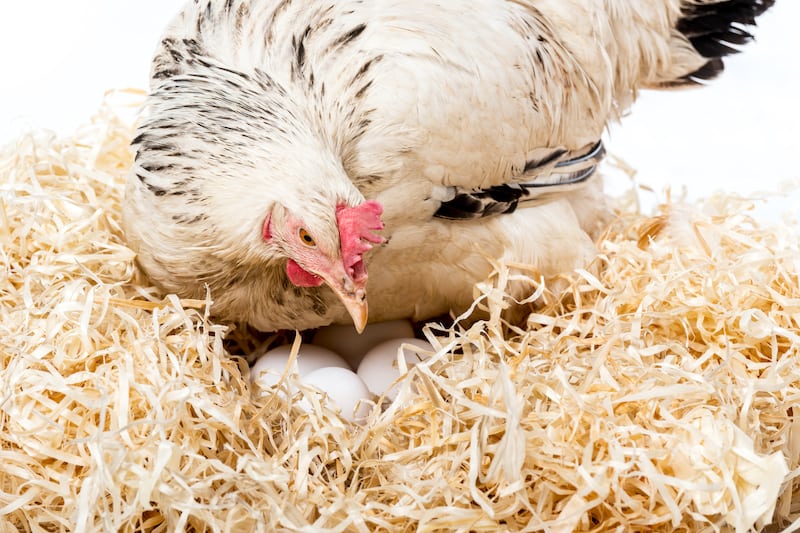
Domestic Chickens
The humble chicken, a familiar face on farms across the globe, brings forth a bounty of eggs that vary in both number and appearance.
Some hens lay one egg a day, while others lay every few days. Yet, there are instances in which these birds defy expectations and produce abnormal eggs.
Stress, diet, and age may influence the variable laying patterns in these domesticated chickens.
While some lay eggs with irregular shells, others, like the silky chicken, produce a consistent egg.