
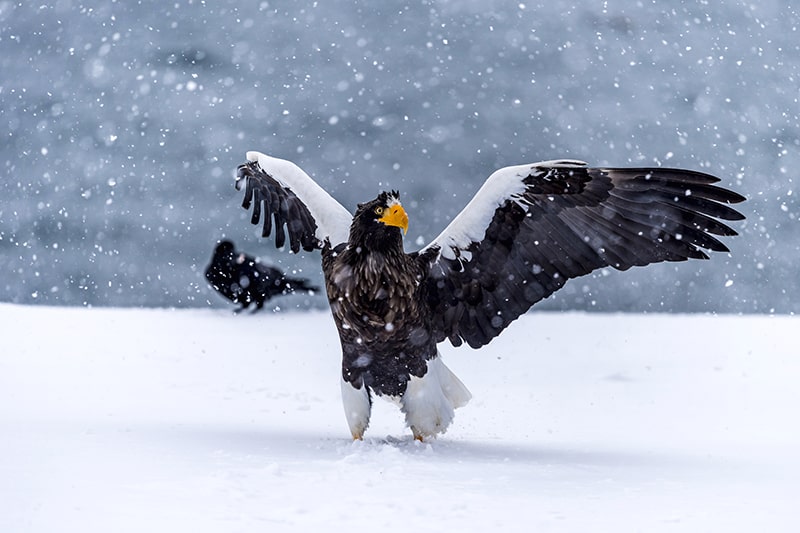
With its yellow eyes, feet, and noticeable bright beak, the Steller’s Sea Eagle is a uniquely identifiable bird.
This impressive raptor species is known for far-reaching migration patterns that can cast it hundreds of thousands of miles outside of its native territory.
Below you’ll find 9 answers to common migratory questions about this majestic bird of the sea:
1. Do All Steller’s Sea Eagles Migrate?
Many Steller’s Sea Eagles migrate as part of their breeding habits and to avoid the harsh winter weather.
However, some don’t migrate out of their home territory.
Instead, these birds move out to open water where they can use oceanic wind currents to stay ahead of cold temperatures and winter storms.
2. Do Steller’s Sea Eagles Migrate Together?
Unlike other types of birds, which sometimes migrate in large flocks of dozens or even thousands of individual birds, Steller’s Sea Eagles tend to migrate alone.
Small groups of sea eagles may migrate along the same coastal territory, but they will fly hundreds of meters apart even if they’re migrating together.
3. How Far Do Steller’s Sea Eagles Migrate?
While some Steller’s Sea eagles stay within a relatively small territory, others migrate thousands of miles to seek out new territory or feeding grounds.
Vagrant individuals are known for migrating the farthest, with some Steller’s Sea Eagles recorded as having traversed entire continents in their travels.
4. Why Do Steller’s Sea Eagles Migrate So Far?
Steller’s Sea Eagles migrate further than many birds in the world, but what causes these giant-sized eagles to migrate so far?
There are several accepted reasons why these eagles of the sea venture far from their home territories during migration:
- Juveniles seeking new territory: Many wide-ranging Steller’s Sea Eagles that are documented are recognized as juvenile individuals in the species. Juveniles often strike out from their home territory in order to establish their own personal feeding grounds and territories in areas with less competition.
- Habitat loss: Overfishing, climate change, and other environmental factors have had negative impacts on the bird’s native territories and feeding grounds. This habitat loss has driven many sea eagles into seeking out more plentiful food and habitat.
- Weather patterns: Storms and other weather can blow migrating Steller’s Sea Eagles off course, causing them to get lost.
While these reasons might be behind some of the wayward eagles that can be found outside of their home territories, they don’t explain everything.
The reality is that scientists aren’t entirely sure why some of these birds end up migrating well beyond their traditional migratory patterns.
5. What Is Vagrancy in Bird Populations?
One of the reasons Steller’s Sea Eagles are so fascinating as a migratory bird is that they have an especially high level of vagrancy in their populations.
In bird behavior, vagrancy is the tendency of individual birds to travel far outside their established home territories or migratory patterns.
Raptors like eagles are generally known to be more vagrant than other species, but Steller’s Sea Eagles are among the most vagrant raptors in the world.
Vagrancy is theorized to partially be a response to climate change in the wild.
6. What Is the Steller’s Sea Eagle’s Home Territory?
Most Steller’s Sea Eagles are found in the Kamchatka Peninsula of eastern Russia, living along the country’s coastline.
This area of the world also makes up the bird’s breeding grounds.
However, the species can also be found in large numbers in parts of Japan or Korea depending on the time of year.
While most Steller’s Sea Eagles stick to the Kamchatka Peninsula most of the year, they tend to migrate inland during the winter months to avoid storms at sea.
7. How Rare Is the Steller’s Sea Eagle?
The Steller’s Sea Eagle is considered a vulnerable species, with only a few thousand individuals left in the wild.
Even though these birds don’t exist in large numbers across the world, their populations in the wild are considered to be relatively stable.
This large raptor lives in remote wilderness areas and rarely comes into direct contact with humans.
8. What Environments Do Steller’s Sea Eagles Prefer?
When migrating, Steller’s Sea Eagles prefer to travel along coastlines, sometimes traveling into the continental interior via riverways.
These hunters of the sky tend to stick to large, wide riverways that contain enough fish to sustain them, with plenty of tall trees and islands to rest on.
9. Where Is the Famous Lost Steller’s Sea Eagle?
Since 2021, ornithologists have been tracking the migratory patterns of a single Steller’s Sea Eagle over 2,500 miles of territory.
The eagle was first spotted outside of its native territory in Alaska, but has since been spotted traveling across the American continent.
Stella, as some have nicknamed, was spotted in Texas before moving on to the eastern seaboard and being picked up again in Canada, Nova Scotia, Massachusetts, and Maine.
Bird experts remain divided on what has caused this rogue Steller’s Sea Eagle to travel so widely outside its traditional migratory patterns.
However, it seems by all accounts to be handling itself just fine wherever it wanders.
Twitter user WanderingSTSE posts North American location updates on the wandering majestic eagle.
Steller’s Sea Eagles Are Explorers
The large size and power of the Steller’s Sea Eagle along with its versatile diet allows it to travel much farther than many other species of bird.
Be birding prepared and ready for travel to catch a glimpse of this fish-eating giant and you might get lucky for a once-in-a-lifetime sighting.
How to Spot a Migrating Steller’s Sea Eagle
Steller’s Sea Eagles generally migrate within eastern Asia.
However, individual birds have been spotted far outside their traditional territories in both North America and western Europe.
In many cases, the white-shouldered eagles can be found hanging out with other large eagle species, such as American bald eagles.
Here are a few of the distinguishing features that set Steller’s Sea Eagles out from other raptors:
- Large yellow beak: Steller’s Sea Eagles have a much broader and more sharply hooked beak than their other eagle cousins, and their nostrils are also large and prominent compared to other eagles.
- White markings: These sea eagles are predominantly dark brown, white white patches at the tail, rump, shoulders, and forehead. There is also a color morph of Steller’s Sea Eagle that has only a white tail and a brownish-black body.
- Large size: The species is one of the largest raptors in the world, with a wingspan that can top out at seven feet across. When placed next to an American Bald Eagle, Steller’s Sea Eagles dwarf them in comparison.
If Steller’s Sea Eagles are noted outside of their home territories, they should be reported to local ornithologists as well as fish and game authorities.
Because there are fewer than 4,000 of these large sea eagles in the wild, their migratory movements are tracked carefully by wildlife biologists.