
Last updated on April 30th, 2022 at 12:42 am
Ravens and crows are popular figures in literature, including modern fiction and ancient lore. They carry many different meanings depending on the context they’re presented in, from dark omens to divinity.
Here are the 7 things a raven or crow can symbolize in literature:
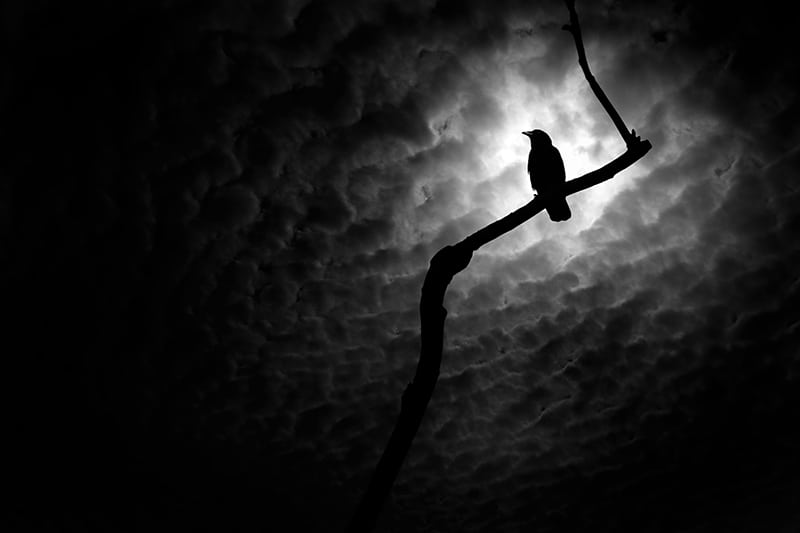
1. Death
A raven can symbolize death, as in Edgar Allan Poe’s The Raven.
In this poem, the raven refers to itself as coming from “Night’s Plutonian Shore,” a reference to the underworld.
It repeatedly says to the speaker, “Nevermore,” a reminder of the finality of the death of the speaker’s love, Lenore.
Here, the raven illustrates the influence of grief on the speaker’s thoughts.
The reason why ravens are often associated with death has to do with what ravens eat.
They eat “carrion,” or dead, decaying flesh, so many authors and storytellers have come to associate them with the deceased.
The association between ravens and death can be seen back in ancient Roman times, when people believed the sight of a black raven to foreshadow bad luck, often involving death.
Additionally, ancient Egyptians recognized the raven as the familiar of Nephthys, their god of the dead.
In Hindu culture, the raven is seen as a messenger between the living and the dead, and it is custom to feed ravens to carry food to loved ones who have passed.
Ravens and crows are also commonly associated with death in TV shows and movies, like in Alfred Hitchcock’s The Birds.
Here, a swarm of crow-like birds attacks people en masse, leaving terror and death in their wake.
The birds are more than a bad omen, as they are directly associated with death.
2. Insight
In Charles Dickens’ Barnaby Rudge: A Tale of the Riots of Eighty, a raven provides important insights to the main character, expanding the protagonist’s consciousness.
Even in The Raven, mentioned above, the bird acts as an extension of the protagonist’s conscious mind, providing deep insights.
You can see this same symbology in the TV show Game of Thrones, in which a raven tells the character, Bran, all kinds of insights due to supernatural powers.
In The Lord of the Rings, crow-like birds carry insights for the villain Saruman, carrying messages from faraway lands and swarming the protagonists to spy on them.
Here they are portrayed not only as insightful but also as evil.
3. Curse
In The Seven Ravens, a fairytale by the Brothers Grimm, a father curses his two sons for a foolish mistake, and the boys turn into ravens as a result.
In the story, the protagonist is the boys’ sister, and she sets off trying to find them once she learns of their curse.
In the end, the boys return to human form to overcome the curse.
In another story by the Brothers Grimm, The Raven, a Queen transforms her screaming daughter into a raven out of annoyance and impatience.
The daughter is then cursed to live life as a raven indefinitely.
The association between the raven and curses goes back to ancient Greek and Roman mythology.
As the story goes, the god of prophecy, Apollo, sends a white raven to spy on his lover, who it turns out is not faithful.
Out of rage, the sun god curses Coronis, singeing the feathers of Apollo’s raven at the same time, turning them black.
4. Foolishness
In the Aesop fable The Fox and the Crow, a crow is taken advantage of by a sly fox who uses the crow’s ability to be flattered as a weakness.
In the story, the crow is perched in a tree about to eat a piece of cheese when the fox comes and, wanting the cheese for himself, starts flattering the bird.
And then saying that its voice must be beautiful. The crow opens its beak to sing, dropping the cheese, and then the fox takes the cheese and eats it.
5. Prophecy
In both Macbeth and Hamlet, Shakespeare uses the raven to symbolize prophecy. In Macbeth, he says:
“The raven himself is hoarse
That croaks the fatal entrance of Duncan
Under my battlements.”
And in Hamlet, he says:
“Begin, murderer. Pox, leave thy damnable faces, and begin!
Come, the croaking raven doth bellow for revenge.”
In both cases, the raven serves as a source of truth, showing what’s to come in the future through its croaking.
You can see the roots of this association between prophecy and ravens in Irish mythology.
They would say that one who has a “raven’s knowledge” has the gift of prophecy.
Additionally, the Greek god of prophecy, Apollo, owned a raven and sent it to do his bidding.
Finally, Aesop’s fables also reference ravens as carriers of prophecy.
In The Crow and the Raven, a crow envies the raven for its ability to see and communicate messages from the beyond.
It tries to pass itself off as a raven to passing travelers, but the crow is unsuccessful.
The moral of the story is to avoid putting on characteristics of others.
6. Divinity
In Asian cultures, the raven is associated with divine intervention and sunlight.
In these myths, the raven is often three-legged and uniquely able to change the course of events in the Earthly plane.
You can most commonly find this symbolism in Japanese, Chinese, and Korean literature and mythology.
There are similar stories about ravens being associated with the divine in Tibetan Buddhism.
For example, a 15th-century story about the monk Ngawang Drakpa involves him searching for the site of a new monastery.
And then following the guidance of a raven when selecting the final spot.
The raven steals his scarf and places it on a juniper tree, marking the site as divine.
7. Witchcraft
In Krabat and the Sorcerer’s Mill, the protagonist is a young boy with an apprenticeship at a mill who slowly realizes that his mentor is teaching him black magic.
In this story, the boy learns to turn himself into a raven as he begins the journey of mastering black magic.
Here, the raven is not necessarily representing evil, but it is associated with dark magical forces and witchcraft.