
Last updated on May 23rd, 2023 at 02:34 pm
Crows are well-known as bad omens, even though they are bright and helpful birds in their ecosystems. So why are they so commonly associated with death?
Crows are associated with death because they feed on dead animals, and of their rituals surrounding death. Crows are scavengers, so they feed mainly on carcasses left behind by other animals. They also engage in mourning rituals when a member of their flock dies.
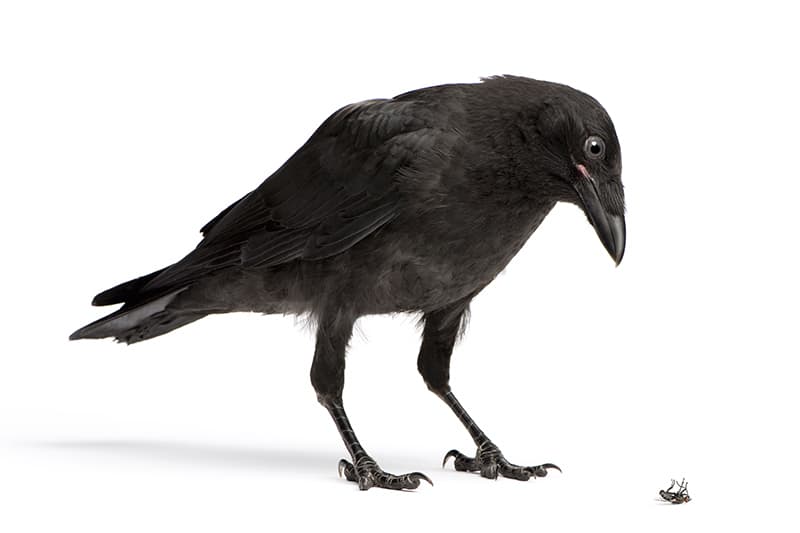
This Is Why Crows Are Associated With Death
There are several possible reasons why crows are associated with death.
The most common beliefs are that it’s because crows are scavengers and because crows mourn their dead.
However, crows are also associated with death due to their color and are associated with plague doctors whose masks resemble their beaks.
They also frequent cemeteries.
Here are 7 reasons crows are associated with death:
1. Scavengers
Crows are scavengers, meaning that they feed on the dead bodies of other animals.
Of all the possible reasons why crows are associated with death, this is the one that’s most commonly cited.
Crows will eat:
- Dead insects
- Snakes
- Frogs
- Large animals like pigs
2. Mourning Rituals
Crows are unique in that they have special mourning rituals when a flock member dies.
The crows will surround the dead body, crowing loudly and ensuring that all members of the flock hear and gather.
Because of this, there is a myth that circling crows will bring death, whether it be to an animal or a human.
3. Back In Black
Perhaps the most straightforward association between crows and death is the jet-black color of their feathers, beaks, and feet.
These monochromatic birds are perfectly dressed for a funeral every day.
Black is commonly associated with evil and bad omens, which is another link between crows and death. However, black is not necessarily an evil color.
4. Plague Doctor Resemblance
During the black plague, doctors wore masks with long beaks resembling a crow.
These beaks held flowers, hiding the smell of the dead with the hope of preventing the disease from spreading.
They looked like crows in these masks, especially when dressed in all black, and in the time of the plague, this meant an association with death.
5. Association with Cemeteries
Crows, with their jet-black feathers and eerie caws, have long been associated with death and cemeteries.
Their presence in graveyards, coupled with their scavenging habits and intelligence, create an unsettling atmosphere that often evokes fear and unease.
In many cultures, crows and ravens are considered to be harbingers of death or omens of doom.
For example, the Norse god Odin, associated with war and death, had two ravens as his companions.
They would fly over battlefields, picking at the carcasses of fallen warriors, and returning to whisper the tales of the dead into Odin’s ear.
Over time, these mythical associations have trickled down into popular culture, casting the crow as a symbol of the macabre.
They often feature in literature and folklore, further entrenching their connection to death and darkness.
Their undeniable presence in cemeteries, with their black plumage contrasting starkly against the often-stark burial grounds, only serves to strengthen these associations.
When observed congregating around tombstones, crows seem to be not only feasting upon the remains of the dead but also acting as otherworldly messengers.
Thus conveying the souls of the deceased to the afterlife.
These associations with cemeteries are further strengthened through the use of symbolism and language.
The expression “as the crow flies” is often used to describe the shortest route between two points.
This suggests that crows have an intimate connection with pathways to the afterlife.
6. Potentially Dangerous
Crows can sometimes be dangerous to humans, as they aggressively protect their territories during mating season.
They’re known for diving and striking their targets repeatedly until the target retreats a safe distance away from the nest, so be warned.
The best thing you can do if a crow attacks you is to figure out where the nest is so you can back away.
7. Predatory
In addition to being scavengers, crows are also predators. They’ve been known to attack small songbirds and eat their eggs and nestlings.
They may even eat adult songbirds from time to time if the opportunity arises. Altogether, crows are among the more aggressive and predatory birds.
Dark Tales and Superstitions
Crows have long cast their shadows over the pages of folklore and myth, becoming symbols of death and harbingers of doom.
It takes little more than a flutter of black wings to understand why these intelligent birds are associated with the darker side of life.
In Celtic mythology, crows were seen as omens of death and destruction. The Morrigan, a goddess of war and death, often took the form of a crow.
She would fly over battlefields, casting a sinister presence that struck fear into the hearts of warriors.
Another dreadful tale comes from the Testament of Solomon, an ancient text that tells of a demon named Onoskelis who appeared to Solomon in the form of a crow.
This bird-like demon influenced people’s dreams, leading them to dreadful nightmares and even harming their bodies.
Superstitions surrounding crows are not limited to ancient times. In the modern era, people often connect a group of crows, called a “murder,” to ominous happenings.
While some interpret a murder of crows as a sign of good fortune, others dread their appearance, believing it foretells death or misfortune.
Many cultures share beliefs about the supernatural powers of crows. For example:
- In Native American folklore, crows are seen as trickster figures who possess magical abilities.
- In Hinduism, crows are believed to represent the spirits of deceased ancestors and feeding crows is seen as a way to pay respect and appease the spirits.
- In Romanian lore, it is said that witches can shape-shift into crows to spy on their enemies.
Though superstitions and folktales may be dismissed as mere stories, their power to evoke fear and fascination is undeniably potent.
As crows continue to haunt our collective imagination, the association between these mysterious birds and death is likely to persist.
Crows That Represent Death in Film and Literature
Many films, books, and works of art feature crows, many centering on the crow’s relationship with death. Crows are often tied to lost souls or a bad omen.
The Birds
In Alfred Hitchcock’s The Birds, a group of thousands of crows haunts a small town, collecting on powerlines, trees, and swing sets.
The birds menace and mob members of the community, even murdering people in their wake.
Interestingly, the footage of mobbing crows in The Birds was real-life footage of crows in a flock, not an animation.
Shakespeare
Shakespeare used crows and their relatives as symbols of bad omen and death in many works, including Macbeth, King Lear, and Hamlet.
In these works, he used the croaking of the crow to invoke fear of the future and a sense that negative things that were foretold would now come to pass.
In addition to crows, he would also use ravens, magpies, and other corvids as such symbols.
Ted Hughes
Ted Hughes’ book Crow: From the Life and Songs of the Crow, published in 1970, follows a protagonist named Trickster through a series of events involving religion, sex, and death.
The author explained that Leonard Baskin’s crow drawings inspired his book.
One of these drawings was used for the cover of the first edition of his work.
Crow-Related Terms and Expressions
In the dark recesses of the human mind, crows have long been linked with death.
These intelligent, resourceful creatures often appear in ancient folklore and mythology, portrayed as harbingers of doom or messengers of the afterlife.
A group of crows is ominously called a murder, but they’re not the only birds with such eerie collective nouns.
Rooks, jackdaws, and magpies are also part of the crow family, known as Corvidae.
Similar to crows, these birds have their own menacing labels which convey an air of mystery and darkness:
- Rooks: Building
- Jackdaws: Clattering
- Magpies: Tidings
Comparatively, other birds’ collective nouns reflect more positive attributes.
For instance, an ostentation of peacocks displays grandeur and beauty, while a parliament of owls suggests wisdom and prudence.
However, a skulk of foxes hints at stealth and deceit within the animal kingdom.
Crows, and their Corvidae kin, make their presence felt in various ecosystems.
They scavenge, hunt, and adapt to their surroundings, often associating with death due to their penchant for feasting on carcasses.
This inclination towards consuming the remains of deceased creatures has cemented their place in human folklore as symbols of death.
The interconnectedness between crows and death inspires artistic expressions throughout literature, visual arts, and popular culture.
This enigmatic relationship is carefully woven into narratives and imagery, touching the delicate balance between life, death, and the ever-present crows.