
Last updated on May 3rd, 2023 at 04:02 pm
Birds have numerous strategies for protecting their babies, from the moment the eggs are laid until the hatchlings grow into adults.
Birds will move their babies to another nest if they believe that predators have discovered their nest. This behavior is most common in waterbirds that are big enough to carry their hatchlings on their backs, such as coots, grebes, and loons.
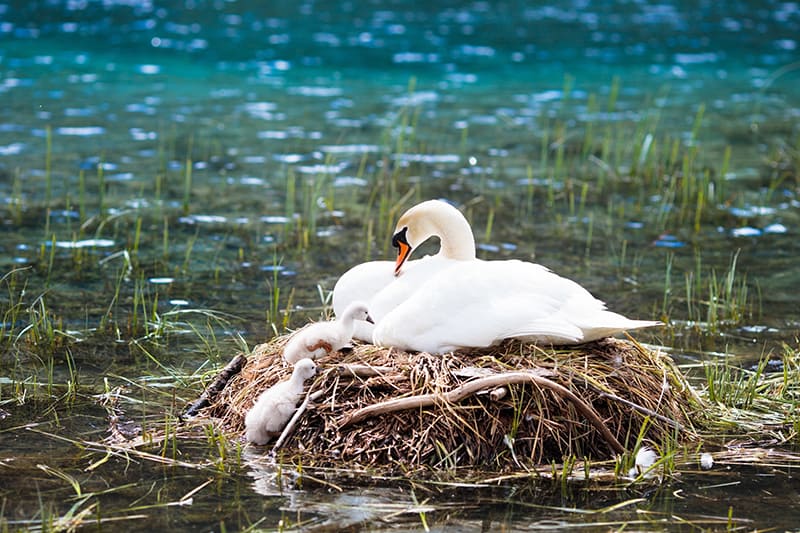
Why Birds Move Their Babies to Other Nests
There are several reasons why a bird might need to move its babies to a new nest, but not all birds can do this.
The most common birds you’ll see transporting their young to a new nesting site are waterbirds; they can carry their young across the water on their backs.
Songbirds are equally protective of their young but cannot physically move them.
Hawks and other birds with long lifespans are more likely to abandon their nests than birds that live a short time.
But abandonment becomes less likely in all birds as the hatchlings grow older.
Some birds will have more than one nest and more than one brood in a year, like the Northern Cardinal or the Mallard.
These birds are more likely to abandon one nest if it is compromised, focusing all their energy on the remaining brood.
This can create the illusion that the bird has moved its nest, but the reality is that the bird has multiple broods.
Below are reasons why birds move their babies to another nest:
It Helps Protect Their Babies From Predators
Birds are very protective of their young, and they’ll take great lengths to keep them safe from predators.
Some birds will even feign a broken wing to draw predators away from their nests.
Others will move their babies to a new nest if they notice signs that a predator is nearby or has discovered their nest.
Will Birds Move Their Babies if Humans Touch Them?
Generally, birds will not move their babies just because a human has touched them.
Birds do not have very strong senses of smell, so they’re unlikely to pick up on human scent if a human touches their eggs or hatchlings.
However, they are sensitive to nest disturbances, so you should still be careful not to touch the eggs.
This is because eggs and hatchlings are fragile and sensitive to disturbances.
How Do Birds Detect Nearby Predators?
Birds rely on their vision and hearing to detect predators, as their sense of smell is not very good.
Cues that a predator is nearby are familiar to birds whether or not they’ve encountered one before due to inherited self-preserving instincts to fear certain kinds of sights and sounds.
There Are Food Sources Elsewhere
Another reason why mother birds move their babies to new nesting spots is to pursue better food sources.
If they’re continually coming up short while foraging, they’ll start shifting further in range until they do find food.
And they don’t want to spend too much energy traveling between food locations and their nests.
How Do Birds Know Where To Find Food?
Most birds rely heavily on their eyesight to find food sources, and they have a good memory for food locations once they find them.
Birds will learn and rely on patterns in food availability, building their territory around fruitful areas to make sure that they and their young have enough to eat.
Birds use a lot of energy, so they need a lot of food, regardless of their age.
Their Nest May Be Broken
Finally, a bird will move its young to a new nest if the old nest becomes broken or damaged in some way.
This can happen due to extreme weather, human disturbance, predator interference, or scavenging birds.
Scavenging birds will gather nesting materials directly from other birds’ nests, so much so that they’ll sometimes force the original nest-builder to relocate.
Non-migrating birds are more likely than others to put the energy into rebuilding a broken nest.
Migrating birds are more likely to head back to their primary range with an unsuccessful breeding season.
Eagles are more likely than other birds to rebuild a broken nest because they use the same one year after year and need it to last.
When an eagle’s nest is damaged or destroyed, it will often build a new one in a location very close to the original.
How Do Birds Move Their Babies to a New Nest?
Some birds, such as waterbirds, transport their babies to a new nest by carrying them on their backs and swimming to a new location.
Waterbirds can do this because they have a body strong enough to carry their young.
See the following video of a swan carrying its young, an example of how waterbirds transport babies to a new nest:
Other birds lack the body strength to carry their young on their backs or would have to balance birds on their backs while flying to reach their nests.
These birds are often forced to choose between leaving their nests and their babies or endangering their own lives trying to protect them.
Will Birds Return Fallen Chicks to Their Nests?
Most birds aren’t capable of carrying their young, and they have no other way to transport their hatchlings if they fall from the nest.
However, once the babies are fledglings, they can get back into the nest on their own.
Should You Put a Fallen Bird Back in Its Nest?
Returning a fallen bird to its nest can keep it safe from predators and make it more likely that a mother bird will continue caring for it.
But you need to make sure that the bird genuinely needs help before you interfere.
You should not move a small bird if it’s old enough to have feathers.
Even though feathered birds are still dependent on their parents, these fledglings are capable of leaving the nest and returning to it without incident.
And you risk more harm than good by moving them.
Make sure that you don’t adopt native hatchlings from the wild, even if they appear abandoned.
Taking hatchlings is against the law in the United States and the allied countries under the Migratory Bird Treaty Act.