
Last updated on November 13th, 2021 at 11:07 am
Are you a birder considering buying a bird spotting scope? This can be quite an investment, so you must consider your needs and research to determine whether it’s worth it.
A bird spotting scope is worth it if you want to track birds over long distances visually. Hawks, for example, fly in circles hundreds of feet up in the air, and unless you’re positioned at high altitude, you’ll need a device with plenty of magnification to watch them.
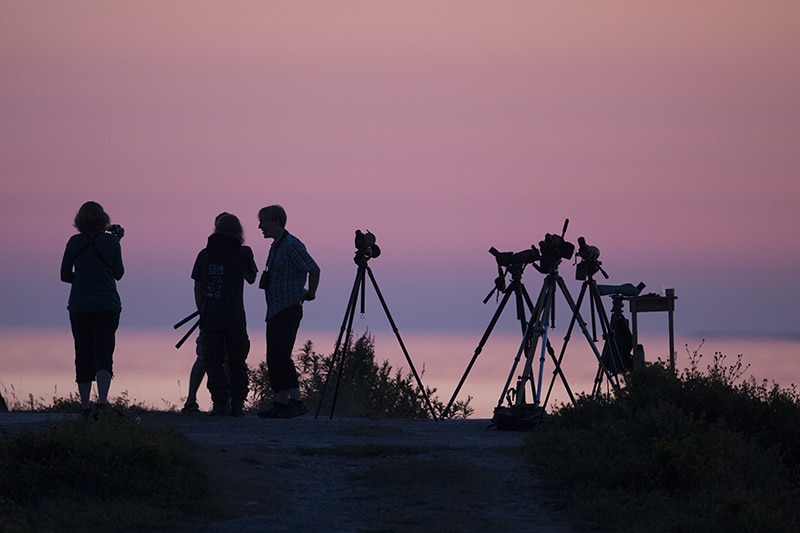
Why Buying a Bird Spotting Scope Is Worth It
Whether or not to buy a bird spotting scope depends on your needs as a birder.
Generally, it’s worth it if you want to capture great detail about the birds you’re watching and can afford to invest in one.
Bird Spotting Scopes Offer Extra Magnification
Bird spotting scopes offer much more magnification than a set of binoculars.
Where binoculars usually hit a zoom maximum at 8-10x magnification, you can find bird spotting scopes with 40-60x magnification.
This extra magnification gives you the power to observe great detail in your subjects without disturbing them by getting too close.
And it allows you to see birds that fly hundreds of feet up in the air, like hawks.
You can also successfully identify birds that would otherwise be far too distant to recognize with a bird spotting scope.
Bird Spotting Scopes Allow You To See in Better Colors
Bird spotting scopes also have large lenses, meaning they draw lots of color and detail into the image.
The point of having a bird spotting scope in the first place is to see birds better and in more detail, so this is a plus, especially if you’re studying them for research.
Downsides of a Bird Spotting Scope
Bird spotting scopes are great as they allow birders to watch birds from a far distance. However, there are downsides in terms of price and portability.
Below are reasons why you may not want to invest in a bird spotting scope.
Bird Spotting Scopes Are Less Portable
The biggest drawback of a bird spotting scope compared to a set of binoculars is that the scope is less portable.
Binoculars are much easier to take on a walk through the woods. A bird spotting scope takes some investment to bring and set up at a birding location.
Bird Spotting Scopes Are Usually Expensive
Bird spotting scopes are also more expensive than binoculars on average, although they do vary.
Be sure to shop around so that your money is well-invested if you choose to purchase a scope.
You may reconsider buying a bird spotting scope if you’re more interested in tracking small, quick-moving birds instead of watching nests, mudflats, or other known bird locations.
Binoculars are much more capable of capturing fast movements compared to a scope.
Bird Spotting Scope or Binoculars?
You may want to consider a pair of binoculars if you’re a beginner birder and progress to using a scope later to develop your interest and skills.
A bird spotting scope is typically more expensive than binoculars. You can always upgrade your gadget next time.
If you love birds so much, eventually, you’ll become a frequent birder, hence looking for a way to enhance your experience.
At this point, investing in a bird spotting scope makes sense.
Suppose you’re not sure whether or not to bird a bird spotting scope; ask yourself what’s most important to you in a birding experience.
Do you want an active birding experience, or do you want to take a sit-and-wait approach?
The more active you’re planning to be, the more it makes sense to stick to a pair of binoculars.
Birds To Watch With a Spotting Scope
Some birds are hard to see in great detail with binoculars because they fly so high up in the sky, they spend their time out on the water, or they’re easily spooked when you get close.
The following are birds that it’s easier to watch with a spotting scope than a pair of binoculars:
- Birds of prey
- Waterfowl
- Shorebirds
But any bird can be captured with a spotting scope if you know where to look.
Fast birds may be difficult to track, but you can learn to aim your scope at a common feeding or perching location and wait for the activity to come to you.
Is It Hard To Set Up a Bird Spotting Scope?
It’s not hard to set up a bird spotting scope, although it takes a little know-how. Generally, you’ll want a tripod to steady the scope.
Simply set up the tripod, attach the scope, and then adjust the aim and focus of the scope according to what you want to watch.
You can also use a bird spotting scope from a vehicle by resting the scope on the window instead of a tripod.
Best Bird Spotting Scopes on the Market
Bird spotting scopes vary in terms of image sharpness, zoom, brightness, and eye relief. Some are straight, and others are angled.
Most are waterproof and fog proof, although you should double-check that the model you’re looking into has these qualities before making a purchase.
Overall, it makes sense to test a few different scopes before you purchase, as you need to find a scope that works well for you and your optic needs.
Birding festivals are a great place to test bird spotting scopes, as veteran birders will often set up their equipment to share with the public.
Vortex Viper HD
The Vortex Viper HD from Amazon.com is compact, with a sharp image and a zoom of 15-45x magnification, controlled via a collar focusing ring that sits on the scope’s body.
One control configures both the fast and fine zoom adjustments.
The objective lens of the Vortex Viper HD is 65mm across, and the glass includes extra-low dispersion elements to reduce visual noise and enhance light transmission.
This results in high color fidelity in every image.
The eye relief is 15-20mm, enough to accommodate users who wear glasses and comfortable for those who don’t. It weighs 53.3 ounces, slightly heavier than average.
Bushnell Elite
The Bushnell Elite spotting scope from Amazon.com has a sharp, bright image and a 20-60x magnification, along with an 88m objective lens and a glasses-friendly 18mm eye relief.
It weighs 53 ounces.
This scope is waterproof and fog proof, with nitrogen-purged housing and RainGuard coatings on the front element to disperse water.
It comes with a sunshade to reduce glare and rubber armor to provide shock resistance and a comfortable grip.
The glass used in the Bushnell Elite spotting scope is extra-low dispersion fluorite glass.
This means that the color contrast and resolution are far above average, essentially eliminating color distortion.