
Observing every quaint feature of many birds in Southern California isn’t a cakewalk. Some bird species don’t reveal their entire bodies due to their perch, and a few features aren’t always lucid, especially colors. But you should be able to spot several yellow-bellied birds in SoCal.
The most prominent yellow-bellied birds in Southern California are goldfinches, orioles, warblers, and tanagers. The other yellow-bellied species here are flycatchers, grosbeaks, kingbirds, meadowlarks, vireos, and waxwings. Plus, there are chats and sapsuckers.
1. Chats
The yellow-breasted chat (Icteria virens) is mainly a migratory bird in Southern California, with a few breeding habitats.
This bulky species has bright yellow breasts, and the color extends to the upper belly, but its lower belly is white.
The yellow-bellied chat-tyrant (Ochthoeca diadema) has a completely yellow belly, but the species isn’t found anywhere in California.
2. Flycatchers
Several flycatchers have yellow bellies, including the following species:
- Brown-crested flycatcher (Myiarchus tyrannulus)
- Dusky-capped flycatcher (Myiarchus tuberculifer)
- Great crested flycatcher (Myiarchus crinitus)
- Yellow-bellied flycatcher (Empidonax flaviventris)
The brown-crested flycatcher breeds in some parts of Southern California, but the other 3 birds don’t have a breeding range or permanent habitat.
Still, you might find a few dusky-capped and great crested flycatchers. The yellow-bellied flycatcher is relatively rare in SoCal.
3. Goldfinches
The American goldfinch (Spinus tristis) wintering in Southern California has yellow bellies. The younger goldfinches of non-breeding age have pale yellow bellies.
You can easily attract these gorgeous goldfinches with Wagner’s Nyjer Seed Wild Bird Food on Amazon.com.
American goldfinches and other finches love nyjer seed.
This 5-pound bag has 750,000 seeds, so you’ll have these granivorous species frequenting your feeders. Also, American goldfinches visit all types of feeders:
- Ground
- Platform
- Hanging
- Swaying in the wind
- Tray
- Tube
The lesser goldfinch (Spinus psaltria) is a permanent SoCal resident, but only the adult males have yellow bellies.
The females and juveniles have dull yellow underparts.
An adult male Lawrence’s goldfinch (Spinus lawrencei) has a yellow belly patch, which is more like a faint wash for the females.
Lawrence’s goldfinches have a permanent presence in coastal SoCal, a large breeding range inland, and a wintering haven in the deserts.
4. Grosbeaks
The evening grosbeak (Coccothraustes vespertinus) wintering throughout the state has a yellow belly.
The females and younger evening grosbeaks have a yellowish-green tinge on their flanks and necks, but the other grosbeak species don’t have yellow bellies or patches.
5. Kingbirds
The western kingbird (Tyrannus verticalis) breeding in most of Southern California and migrating through the rest has a bright yellow belly.
Cassin’s kingbird (Tyrannus vociferans) has a slightly paler yellow belly and has a much smaller presence in SoCal than the western kingbird.
The tropical kingbird (Tyrannus melancholicus) also has a yellow belly.
Although this species is largely limited to its tropical range, a few thousand of these birds are found throughout SoCal.
6. Meadowlarks
The western meadowlark (Sturnella neglecta) is a permanent resident of Southern California and the rest of the state.
The breeding adults have bright yellow underparts, from the throat to the belly. They also have a black v-shaped mark on their chests.
The non-breeding western meadowlarks have a bright yellow throat, but the underparts are a slightly lighter or paler shade.
7. Orioles
The hooded oriole (Icterus cucullatus) breeds throughout Southern California.
The males have a vibrant yellow belly that turns orange around their breasts, while the female has an olive-yellow belly.
The male Bullock’s oriole (Icterus bullockii) breeding in SoCal has a yellowish-orange belly, but the females have a whitish patch.
Scott’s orioles (Icterus parisorum) breeding here have lemon yellow bellies, whether breeding or younger males. The females have yellowish olive bellies.
The orchard oriole (Icterus spurius) males don’t have a yellow belly, but the females do.
These orioles don’t breed in Southern California, but quite a few are seen in various places.
8. Sapsuckers
Williamson’s sapsucker (Sphyrapicus thyroideus) has a yellow belly, but you may fail to spot it if the bird is clung to tree bark.
The yellow underparts are visible only when the sapsucker isn’t busy drilling holes and feasting on sap.
The yellow-bellied sapsucker (Sphyrapicus varius) doesn’t breed in Southern California, nor is it a year-round resident.
Still, you may spot a few in SoCal, but this species has a whitish belly. A few have pale yellow underparts, but the feature or color may not be very prominent to birders.
9. Tanagers
You’ll find at least 4 tanager subspecies with yellow bellies in Southern California:
- Hepatic tanager (Piranga flava)
- Scarlet tanager (Piranga olivacea)
- Summer tanager (Piranga rubra)
- Western tanager (Piranga ludoviciana)
All western tanagers have yellow bellies, including:
- Breeding males and females
- Adult males and females
- Non-breeding and juveniles
Summer tanagers breed in SoCal, but only the females and immature males have yellow bellies. Hepatic tanagers breed in isolated habitats.
The juveniles and females have yellow bellies, but the adult males don’t.
Likewise, the female and non-breeding male scarlet tanagers have yellow bellies, but they are relatively scarce in California and SoCal.
10. Vireos
Bell’s vireo (Vireo bellii) breeds in Southern California, but this western subspecies doesn’t have a yellow belly. Those with yellow bellies are eastern Bell’s vireos.
The white-eyed (Vireo griseus) and yellow-throated vireos (Vireo flavifrons) have a yellow wash and throat.
Although these two subspecies don’t breed in SoCal, nor do they have a permanent presence, a few sightings have been reported by birders.
11. Warblers
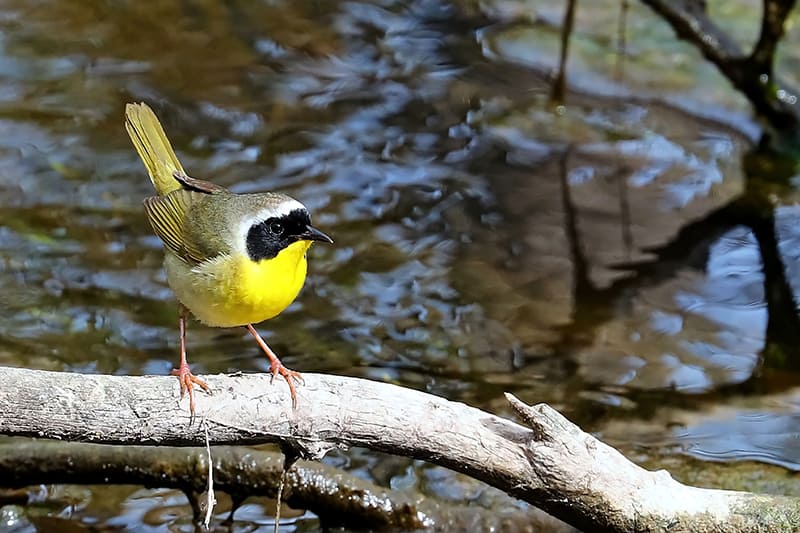
Warblers are the most prevalent yellow-bellied birds in SoCal, including the following species:
- Common yellowthroat (Geothlypis trichas): year-round
- MacGillivray’s warbler (Geothlypis tolmiei): migrating
- Nashville warbler (Leiothlypis ruficapilla): migrating
- Orange-crowned warbler (Leiothlypis celata): migrating
- Palm warbler (Setophaga palmarum): wintering
- Wilson’s warbler (Cardellina pusilla): migrating
- Yellow warbler (Setophaga petechia): breeding
Also, you are likely to find the following warblers with yellow bellies in Southern California:
- Blue-winged warbler (Vermivora cyanoptera)
- Hooded warbler (Setophaga citrina)
- Mourning warbler (Geothlypis philadelphia)
- Prothonotary warbler (Protonotaria citrea)
These 4 warblers don’t breed in Southern California, nor do they have a definitive wintering or migrating presence.
However, a few hundred of each of these warblers are seen in SoCal.
12. Waxwings
The cedar waxwing (Bombycilla cedrorum) winters throughout California and is a fairly common bird at backyard feeders.
Cedar waxwings have a pale or lemon-yellow belly, but the juveniles have whitish bellies. These birds are often seen in flocks, so they are a delight to watch.