
Last updated on April 22nd, 2022 at 08:11 pm
Woodpeckers can hit their beaks hard against trees and other hard surfaces 20 times per second, sustaining the effort over a long time without undergoing brain damage. But how do they do it without damaging their heads?
Woodpeckers protect themselves from head injuries by varying their pecking patterns and using their special skulls. Their skulls are built with a small bone that wraps around the head and keeps the skull in place, and their skull bones are also flexible, which reduces the chance of injury.
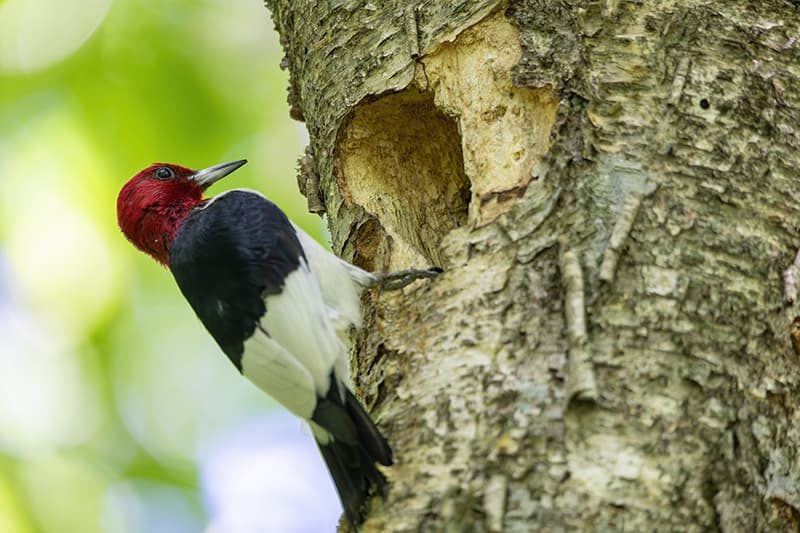
How Do Woodpeckers Protect Their Heads?
Woodpeckers would be prone to concussions and headaches from pecking hard at trees if it weren’t for the way their heads and bodies are built.
Additionally, woodpeckers engage in certain patterns of pecking that are less likely to do damage than others.
Woodpeckers also hold on tight to their perch while pecking, which helps them absorb some shock.
This prevents them from suffering injuries even when pecking on tough surfaces like tin roofs or hard trees.
How a Woodpecker’s Skull Protects It From Impact
Woodpeckers have a flexible, plate-like set of bones in their head that minimizes the damage of pecking and a special bone called a hyoid bone.
This bone wraps around the skull and down the beak, acting as a kind of seat belt.
It holds the skull in place when the woodpecker is pecking.
Woodpecker skulls are also stronger than other birds’ bones.
Their skulls are thin but stiff and strong, and they have less fluid between the brain and skull than other birds have.
Because woodpeckers don’t have as much fluid around the brain, the brain doesn’t move around as much.
Therefore, it undergoes less of an impact when the woodpecker is pecking.
How a Woodpecker’s Tongue Protects Its Brain
Woodpeckers have a specialized tongue that wraps around the back of the skull and brain, anchoring at the front of the head just between the eyes.
The tongue works like a spring, absorbing the shock of the impact so there’s less stress on the bones and the brain itself.
How a Woodpecker’s Beak Is Built for Pecking Safely
Woodpeckers also have a special kind of beak that protects them from brain injuries while they’re pecking.
Its upper beak is longer than the lower beak, but the lower beak has a longer bone supporting it.
This placement makes it so that most stress from pecking goes into the body rather than the head and brain.
How a Woodpecker’s Pecking Pattern Minimizes Impact Damage
Additionally, woodpeckers reduce the chance that they’ll suffer brain damage from pecking by using certain pecking patterns.
Most importantly, these patterns involve moving their beaks around from position to position while pecking.
These patterns spread out the shock of impact across various regions of the head instead of chronically focusing on one part of the brain.
How a Woodpecker Balances To Avoid Injury
Woodpeckers also avoid injury while pecking by sitting with its tail propped against the pecking surface.
This ensures that the shock from pecks travels through the neck and into the upper torso.
It spreads the shock across the body instead of concentrating it all on the head.
Woodpeckers can do this because they have long, stiff tails.
Do Woodpeckers Ever Get Concussions?
Woodpeckers don’t get concussions from pecking, but other impacts can hurt them.
For example, if a woodpecker flies into a window, its specialized skull and tongue won’t prevent it from undergoing damage.
Its head is built to withstand continuous pecking, but it isn’t immune to all impact damage.
How You Can Protect Woodpeckers from Impact Damage
The most important thing you can do to protect the woodpeckers in your area from impact damage is to keep them from crashing into your windows.
You can do this by installing reflective tape or another shiny object near the windows to scare the birds away.
You can also install a window pattern that makes it obvious a window is a solid object.
For example, these Window Flakes Anti-Collision Window Clings (available on Amazon.com) are made to prevent birds from flying into windows accidentally.
These are a good investment because about a billion birds die from window strikes every year in the U.S., and clings like these will lower that figure.
How To Support Woodpeckers
In addition to preventing impact concussions and death by window strike, you can support woodpeckers by providing appropriate food.
This is especially true during the migration seasons and winter months.
What Should You Feed Woodpeckers?
Woodpeckers eat a wide variety of foods.
You should feed woodpeckers the following:
- Suet
- Peanuts
- Tree nuts
- Mealworms
- Sunflower seeds
- Sunflower chips
- Cracked corn
- Fruit
- Nectar
Setting Up Nest Boxes for Woodpeckers
Woodpeckers nest in cavities of trees, so nesting boxes feel familiar to them and can be a good substitute for a place in the trees.
Just make sure that you set up the nesting box according to the woodpecker’s needs if you want to attract and take care of them.
They require a larger than average entrance hole on a nesting box.
So if you want to attract woodpeckers to one, you’ll need to make sure the entrance is at least 2 ½” (6.35 cm) in diameter.
You should also install the box on a tree or pole that’s 6’-12’ (1.83-3.66 m) high, about the natural distance from the ground where woodpeckers live.
Woodpecker nest boxes do best when they’re in a shaded open area, close to a wooded area but not buried in the forest.
That way, the birds can quickly fly to cover from the box but still don’t have predator hiding places right near their nests.
Ensure that you install a baffle on your nesting box pole if you have one, or you might find that snakes or cats have eaten the small woodpeckers.
You can buy a woodpecker house such as the BestNest Woodpecker House (available on Amazon.com).
This box, in particular, has an entrance hole reinforced with metal to prevent the woodpeckers from enlarging the hole and letting predators inside.