
Last updated on May 17th, 2023 at 11:48 pm
Puffins, also known as “clowns of the sea” or “sea parrots,” are a unique set of species with an even more unique name.
Puffins got their name because of their distinct appearance. Their downy feathers make them appear puffed. The nicknames “clowns of the sea” and “sea parrots” are appearance-based, as well. Both are references to the birds’ colorful facial markings and beaks.
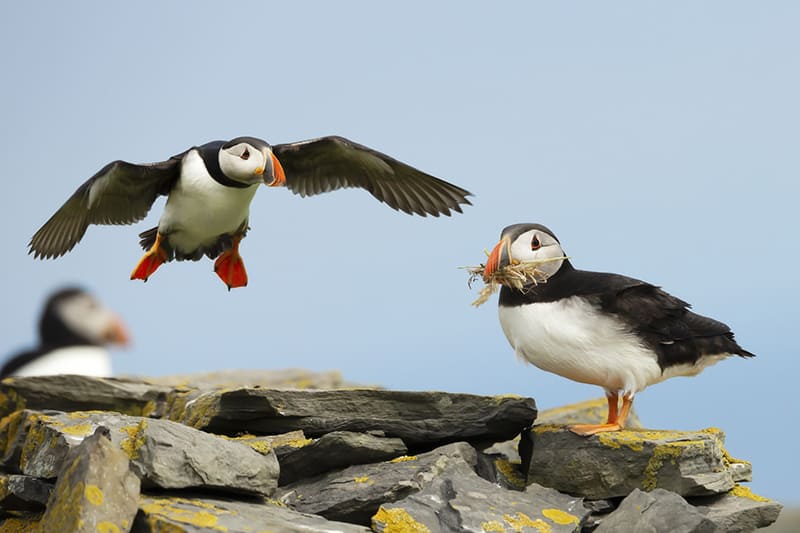
How Did Puffins Get Their Name?
Puffins were named upon discovery, with each species getting its variation based on different characteristics.
The general “puffin” part of each name refers to these seabirds’ puffy nature, especially the downy, puffed appearance of the young pufflings.
The various puffin species include:
- Atlantic Puffins
- Horned Puffins
- Tufted Puffins
- Rhinoceros Auklet
All puffins share the genus Fratercula.
Common Names/Nicknames
Puffins are known as “clowns of the ocean” due to their facial markings and are called “sea parrots” because of their colorful, toucan-like beaks.
These informal names developed over time after the official name had been decided.
The Atlantic Puffin is named after where it lives, the North Atlantic, whereas the Horned Puffin and the Tufted Puffin are named after their appearances.
The Horned Puffin has horny projections over its eyes, and the Tufted Puffin has long, yellowish feathers that extend from the top of its head.
The Rhinoceros Auklet is also called the Horn-billed Puffin or the Unicorn Puffin. Both names are related to the distinctive horns on their beaks.
Scientific Name
Puffins have several different scientific names depending on the species, but they all share the genus Fratercula.
Fratercula means “little friar,” a reference to the puffin’s black and white patterned feathers, which resemble a friar’s robes.
Some also say that the name refers to the way puffins clasp their feet together as if in prayer.
The full scientific names for puffins are as follows:
- Fratercula arctica (Atlantic Puffin)
- Fratercula corniculata (Horned Puffin)
- Fratercula cirrhata (Tufted Puffin)
- Cerorhinca monocerata (Rhinoceros Auklet)
French zoologist Mathurin Jacques Brisson first gave the puffin its scientific name in 1760 after discovering the Atlantic Puffin.
In addition to puffins, Brisson also discovered godwits.
How Do Birds Get Their Names?
Birds are first named when they’re identified as a new species.
In the United States, a committee of the American Ornithologists’ Union meets to discuss common names.
It then adds the new bird to the Checklist of North and Middle American Birds.
Birds get their scientific names from their genus and species epithets.
They can get their common names from several factors, including their plumage, songs, genetics, range, or relation to other species.
Ornithologist society members determine a unique and descriptive name from these attributes.
In some cases, the committee will choose a name that describes the one who discovered the species.
For example, Brewer’s blackbird was named after naturalist Thomas Mayo Brewer, and Steller’s Jay was named after naturalist Georg Wilhelm Steller.
See the following chart of birds and the reasons why they got their names:
| Name | Origin |
| Black-capped Chickadee | Named after the sound it makes |
| Whistling-ducks | Named after the sound it makes |
| Clark’s nutcracker | Named after discoverer William Clark of Lewis and Clark |
| Lewis’s Woodpecker | Named after discoverer Merriweather Lewis of Lewis and Clark |
| Tufted titmouse | Named for its distinctive crest |
| Broad-winged Hawk | Named for the shape of its wings |
| Swallow-tailed Kite | Named for its forked tail |
| Acorn Woodpecker | Named for its favorite food and how it stashes them every year |
| Black Skimmer | Named for the way it skims the top of the water hunting for fish |
| Cooper’s Hawk | Named after naturalist William Cooper |
| Bonaparte’s Gull | Named after Prince Charles Lucien Bonaparte, nephew of Napoleon Bonaparte |
| Wilson’s Warbler | Named after writer Alexander Wilson, author of American Ornithology |
| Green Jay | Named after its bright color |
| McCown’s Longspur | Named after Confederate Major-General John Porter McCown |
| Cedar Waxwing | Named after the waxy tips on its feathers |
| Ruby-crowned Kinglet | Named for the color of its head |
| Black Oystercatcher | Named after its dark black plumage |
| Williamson’s Sapsucker | Named after researcher Robert Stockton Williamson |
| White-eyed Vireo | Named after its pale eyes |
| Red-bellied Woodpecker | Named after its red chest plumage |
| Red-winged Blackbird | Named for the red markings on its wings |
| Anna’s Hummingbird | Named after Princess Anna D’Essling, Duchess of Rivoli |
| Lucy’s Warbler | Named after Lucy Hunter Baird, daughter of ornithologist Spencer Fullerton Baird |
| Cuckoo | Named after the sound it makes |
| Chiffchaff | Named after the sound it makes |
| Kittiwake | Named after the sound it makes |
| Dartford Warbler | Named after the place where it was originally found |
Note that those birds who are named after their plumage may not all have the eponymous colorings.
Dimorphic birds like the red-winged blackbird will have varied plumage based on sex, and only the males have distinctive red wings.
For more on how birds got their names, see Mrs. Moreau’s Warbler: How Birds Got Their Names by Stephen Moss, for sale on Amazon.com.
This book is written by a real-life naturalist who works for the BBC Natural History Unit and is a lecturer in Nature and Travel Writing.
Do Birds’ Names Ever Change?
Birds’ names change as new information is discovered. Sometimes one species is split into separate species. At other times, two formerly separate species become one.
For example, the growing list of differences between the eastern and western forms of the rufous-sided towhee led to an official split.
This resulted in the spotted towhee in the West and the Eastern towhee in the East.
As another example, the Iceland gull and the Thayer’s gull were reevaluated and determined to be the same species in 2017.
They had previously been separated into two species in a 1973 decision, which the committee officially reversed.
Like these gulls, the red-shafted flicker and the yellow-shafted flicker also became part of the same species. They are now both considered variations of the Northern flicker.
This change happened because so many hybrids were found between the two, proving that they could mate together.
Some proposals for name changes are still pending, like recognizing hoary redpolls and common redpolls as members of the same species.
Although the effort has gained some scientific support, it has yet to pass.