
Last updated on October 9th, 2022 at 10:23 pm
It can be hard to figure out what bird you see flying overhead, but narrowing it down by which birds are active in your area can help.
Here are 9 common Florida birds that fly at night:
1. Eastern Whip-Poor-Will
The Eastern Whip-poor-will is a gray and black medium-sized bird about 10” long.
This Florida night-flier can be recognized by its erratic flight pattern, which resembles the flight pattern of a moth.
Its wings are mottled, its tail is square, and it has a rounded, all-purpose bill.
You’ll most commonly hear the Eastern Whip-poor-will calling on spring and early summer nights when the breeding males sing.
Eastern whip-poor-wills are most common in heavily wooded areas.
And although they remain common, their populations have been on the decline for the last half-century due to large-scale deforestation for agriculture and development.
2. Yellow-Breasted Chat
The Yellow-breasted Chat has a weak, fluttering flight pattern, and it flies for short durations between breaks.
It has a fan-shaped tail with rounded wings and a remarkable bright yellow chest.
Its outer plumage is olive green with dark markings, and it has a few small white markings by the eye and white rear.
The Yellow-breasted Chat is about half a foot long, with a wingspan of 9”-10”.
Known by the scientific name Icteria virens, this species is one of Least Concern according to international environmental authorities.
It remains common across its range despite the influences of development and agriculture on deforestation.
The bird lives across most of the central U.S. during the breeding season, then migrates south to Mexico and Central America during the non-breeding season.
3. Barred Owl
The Barred Owl is relatively small, bigger than a crow but smaller than a Great Horned Owl or a goose.
They have mottled brown and white plumage and are known for being graceful flyers who dance lightly through the air and navigate thickly forested areas quite well.
You can identify a Barred Owl by its trademark call, “Who cooks for you?”
Barred Owls are usually asleep during the day and then hunt at night, but you can sometimes hear them during the day.
These birds used to be a lot more common in the American South, but they’ve migrated into new territories with the loss of swamp habitat.
The northwestern part of the species’ range has expanded.
For the most part, the Barred Owl lives in the eastern half of the United States, but some live across Canada and in the Pacific Northwest and Idaho.
4. Northern Mockingbird
The state bird of Florida, the Northern Mockingbird, is also one of the state’s most active at night. Because it mimics the calls of other birds, it can be hard to identify.
In fact, the Northern Mockingbird can mimic almost 200 different songs inspired by other birds.
You can recognize a Northern Mockingbird by its flight pattern, consisting of a few strong wing strokes followed by a pull of the wings to the sides.
The bird is white and gray, with dark plumage on its sings and tail. It’s medium-sized, about 10” in length.
See also our article on common animals that sound similar to birds.
5. American Robin
The American Robin is a bird that isn’t naturally nocturnal but that’s been starting to become more active at night to adapt to city life in Florida and elsewhere.
Because of artificial light, the birds cannot easily differentiate day from night, and the cities are so noisy during the day that the birds wait until late at night to converse.
It’s unclear whether this pattern is harming the American Robin population, but it is clear that it’s causing a great energy expenditure.
Instead of sleeping, these birds are forgoing rest and stay up to chatter.
Some environmentalists have recommended reducing light output at night and controlling noise pollution as ways of helping the American Robin retain a more natural schedule.
You can recognize an American Robin in flight by its “flap and bound” flight style.
It’s a pattern of several smooth flaps followed by a short glide with wings held close to its body.
6. Chuck-Will’s-Widow
The Chuck-will’s widow is a large brown nightjar with a flat head and a few white stripes on the tail.
They tend to roost in the same place day after day, usually on a branch or even on the ground.
This nightjar is active at night, and you can sometimes recognize them by the way they glide over the trees and perform their wing-clapping display.
They can also be seen hunting. Chuck-will’s-widows are most common in the southeast parts of the United States, inhabiting deciduous forests and pine barrens alike.
These birds are known for their ability to camouflage, but if you keep your senses heightened, you might just notice the flutter of a Chuck-will’s-widow flying overhead.
7. Common Nighthawk
Common Nighthawks have a distinctive looping pattern to their flying, and they’re typically out in the early mornings and late evenings.
During migration seasons, you can find common Nighthawks in flocks in areas rich in insects, like lakes.
You can identify a Common Nighthawk by its “peent” call. See an example of the Common Nighthawk’s call in the video below:
8. Antillean Nighthawk
The Antillean Nighthawk is a brown, 8” long bird with a very small, rounded beak and brown plumage with white accents.
Its feathers have heavy black barring, and its neck and tail have white markings as well.
An Antillean Nighthawk is recognizable by its darting, fluttering movements.
The flight pattern is erratic, often changing direction while beating at a slow rhythm.
And when its wings are outstretched, you’ll notice that they have pointed tips and white markings.
The tail is notched and banded with white and brown.
9. Eastern Screech-Owl
The Eastern Screech-Owl is very active at night, defending their territory and working together with their family to stay safe from predators and stay well fed.
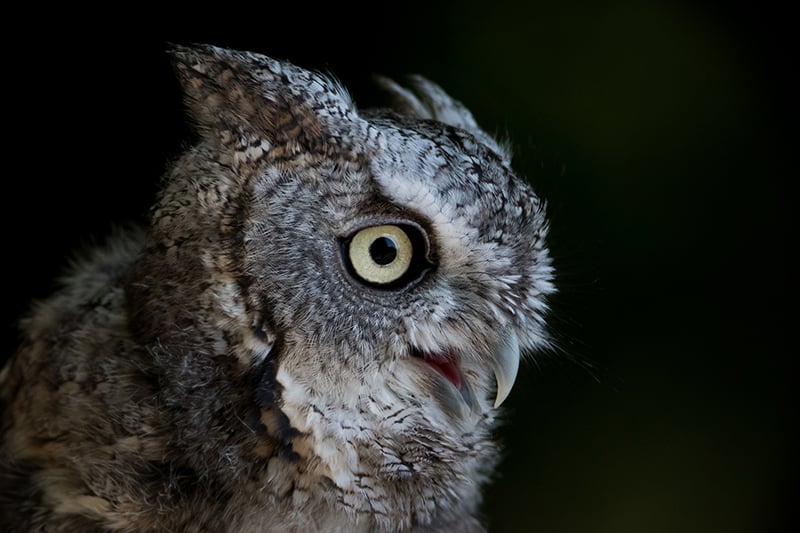
These owls have large yellow eyes and ear tufts and are relatively small at just 7”-10” in length.
They are very difficult to hear flying overhead, but you can recognize the Eastern Screech Owl’s flight by its buoyancy.