
Both digiscoping and telephoto lenses are good options for photography, though each has different benefits and weaknesses. The more effective one depends on what you need it for.
A digiscoping lens is more effective because it can attach a camera to a more powerful lens. A telephoto lens is more limited. Digiscoping lenses also tend to be less expensive on average, and they can be attached to a smartphone, making them convenient for amateurs.
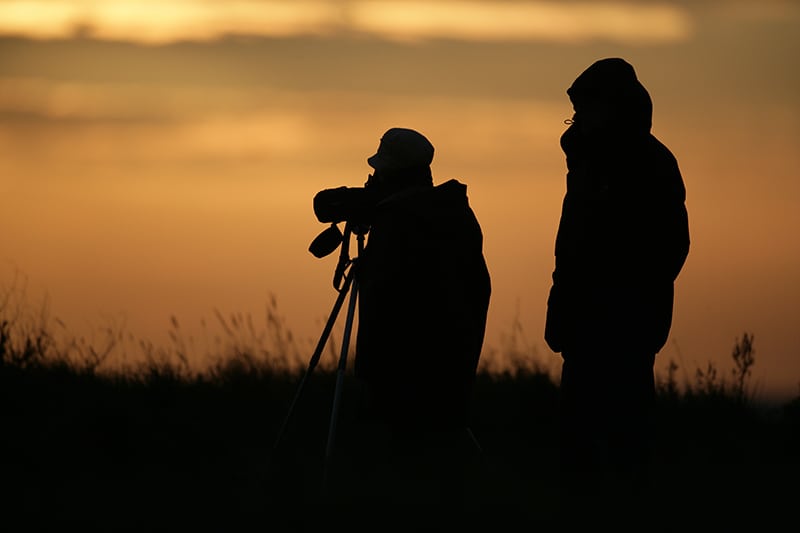
Should You Use a Digiscoping or Telephoto Lens?
You should use a digiscoping lens if you want more detail when birding.
Although a telephoto lens can capture some detail, digiscoping lenses open up even more possibilities by allowing you to attach a camera to an even more powerful lens.
Plus, digiscoping lenses tend to be less expensive.
Benefits of a Digiscoping Lens
A digiscoping lens has many benefits.
Because the lens is sold separately from the camera itself, it tends to be less expensive despite its usually higher degree of magnification.
Plus, many digiscoping lenses can be attached to a smartphone, so they do not necessarily require an investment in an expensive camera.
See, for example, the AccessoryBasics Adapter Mount (available on Amazon.com).
This attachment can connect a smartphone to many different digiscoping lenses, allowing you to take photos or videos right on your device through a powerful lens.
A digiscoping lens produces the best results when you can snap photos with little movement, so try using a remote firing device to take photos if you’re using a smartphone.
Tapping the screen to take photos can shake the device and ruin the focus.
Additionally, you may want to use something heavy like sandbags to balance the digiscope, especially if you don’t have a tripod.
Digiscoping lenses today are easier to set up and use than they used to be.
The lenses could only attach to a few specific kinds of cameras in the past.
Now you can use them with almost any smartphone and a range of cameras, which makes these lenses all the more valuable and useful.
Benefits of a Telephoto Lens
One of the main benefits of a telephoto lens is that it’s more likely to have an autofocus feature.
Because digiscopes are separate from the camera itself, it requires more manual adjustments.
Telephoto lenses, by contrast, can focus automatically as you’re looking through the lens and preparing to take a photo.
Telephoto lenses have a great deal of zoom relative to most camera lenses, and to qualify, they must have a focal length of at least 60 mm.
You may also find what’s known as a “medium telephoto” lens, with a focal length between 70 and 200 mm, and a “super-telephoto” lens, with a focal length longer than 300 mm.
The bigger a telephoto lens is, the more important it will be to invest in a tripod to steady the camera while you’re out in the field.
Otherwise, you’ll get shaky photos because it’s too difficult to steady the large lens.
You might try using a telephoto lens if you have the resources to invest in a broad range of photography equipment and want a dedicated wildlife photography camera.
However, having a more versatile scope is preferable for many.
Still, a telephoto lens is a good choice for some in certain contexts.
How To Choose the Right Digiscoping Lens
To start digiscoping, you’ll need to find a lens that you can attach to a camera.
Usually, these lenses are called a spotting scope, a monocular, or a telescope.
They may, however, be marketed as a digiscoping lens. Regardless, you just need to ensure that the lens you choose is compatible with your camera adapter.
There are several key features that you should look for in a lens, from the ease of focusing to the kind of coating on the lenses.
Ease of Focus
Like the Solomark Spotting Scope (available on Amazon.com), some digiscoping lenses have an easy-to-use focus wheel, whereas others require more practice and finesse.
Choosing a digiscoping lens that’s easy to adjust the focus on will make it easier for you to scan the area and choose different targets to zoom in on.
If you plan to watch one particular spot, like a nest or a feeder, you may find that you can sacrifice ease of focus in favor of other positive features.
Lens Coating
Multi-coated optics play an important role in providing a bright image and reducing chromatic aberration in your field of vision.
This is especially noticeable when you attach a camera and start snapping photos through your lenses.
The Celestron Ultimate Angled Spotting Scope (available on Amazon.com) is the perfect example of a spotting scope with a good lens coating.
The multi-coated optics in this scope provide anti-reflective features and brightness even in low-light environments. This lens is also larger than average at 80mm.
However, it is also bulky, so you’ll need a stabilizing tripod.
Clarity
Another important feature in a digiscoping lens is clarity.
To provide sufficient clarity, a lens must let in a significant amount of light and provide a picture without distortion, even when the zoom is applied.
If you want clarity at high magnification, you’ll need to invest in a digiscoping lens of a larger size. But this will mean a heavier and bulkier device.
Price
Digiscoping lenses vary a lot in price, so make sure you shop around and investigate your options before purchasing.
Keep in mind that larger lenses will usually cost more, though they also provide more magnification.
You might find that investing in a high-quality digiscoping lens from the get-go is the best course for you in the long run.
This is because inexpensive options might break or fail to produce the results you’re looking for.
Weatherproofing
Chances are that you’re planning to use your digiscoping lens outside in the elements, where you’re likely to be caught in the rain, wind, or maybe even snow.
Therefore, your lens must be up to the task of spending long hours outdoors in all conditions.
Make sure that whatever lens you choose is fully weatherproof and rugged, and able to withstand some basic wear and tear.