
Binoculars are a great gift for kids because they teach them exploration skills and start them birding at a young age.
But what features do you need in a pair of child binoculars? What resolution should you choose?
When it comes to binocular resolution for kids, more is better. Several manufacturers sell high-resolution binoculars made for children as young as 3. However, more magnification is not better. For young kids, you should aim for a magnification between 2x and 8x.
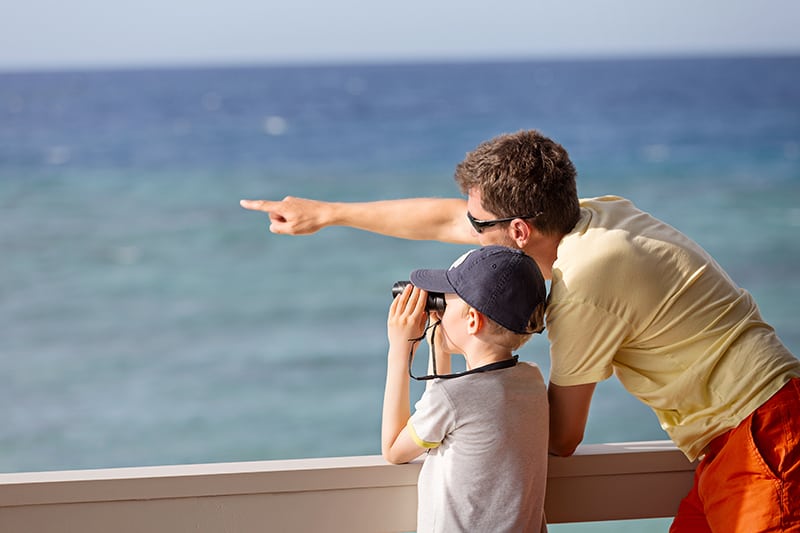
Why Kids Binoculars Need a High Resolution
High resolution in binoculars for children allows them to see the fine details of what they’re looking at, and there’s no harm to too much resolution.
Remember that when you magnify the image, the resolution goes down.
So, if you buy a pair with adjustable magnification, you’ll want a higher resolution to compensate for the change that happens with a change in magnification.
An example of high-resolution kids binoculars is the Kidwinz Original Compact Binoculars, sold on Amazon.com.
These binoculars also have 8x magnification, are shockproof, and can be adjusted to fit each face.
Another pair of kids binoculars with high resolution are the Dreamskope Kids Binoculars, made for kids aged 3-9 and sold on Amazon.com.
These binoculars have 8x magnification, a breakaway neck strap, and a lifetime warranty in case of defects.
The company that sells them is so confident in their ruggedness that they’ll replace any broken pair.
What Magnification Is Best for Kids Binoculars?
When it comes to magnification in child binoculars, more isn’t necessarily better.
For kids under the age of 10, binocular magnification between 2x and 8x is best. Generally, the younger the child, the lower the magnification should be.
Kids tend to be less steady with their binoculars, which means that they’ll have difficulty focusing with very high magnification.
It’s better to start kids with a lower magnification.
A great example of an 8x magnification set of binoculars for kids is the OBUBY Binoculars with High-Resolution Optics.
This pair of binoculars, sold on Amazon.com, is shockproof so that your child doesn’t have to worry about them breaking easily.
They come in 13 different colors, including blue, green, and red.
For younger kids, the Educational Insights GeoSafari Binoculars may be more appropriate.
These binoculars, which have 2x magnification, are sold on Amazon for a reasonable price.
They’re great for kids aged 3+ because of their easy-to-use shape, fun colors, and breakaway neck strap.
They are not water-resistant, however, so keep them dry.
How Much Do Kids Binoculars Cost?
Kids binoculars cost somewhere between $15 and $50. Most pairs will be around $30, although it depends on what features you choose.
Factors that increase the cost of a pair of kids binoculars include higher magnification, more rugged build quality, and a wider field of view.
If you’re just starting to bird with a kid, you might consider making DIY cardboard binoculars just to get them started with the idea of a scope.
Simply punch holes in two toilet paper or cut paper towel rolls, then run a string through them to create a lanyard.
You can then glue the two rolls together so that they resemble binoculars.
DIY cardboard binoculars are great because they teach kids how to focus their field of view on a particular area when looking for birds.
This is true even though they don’t have any magnification powers.
Other Factors To Consider When Buying Child Binoculars
These are some other factors you should consider when buying child binoculars:
- You should find a lightweight pair. Kids can’t hold as much weight for long periods, so be sure to find a pair that doesn’t weigh much.
- The binoculars should have a small interpupillary distance. Kids don’t have as much space between their eyes, and the binoculars should account for that.
- Look for a wide field of view. Kids will have an easier time finding the subject they’re trying to focus on if their binoculars have a wide field of view.
For kids under the age of 5, you’ll also need to look for these things:
- Padded eyepieces to make the binoculars more comfortable and easier to get used to.
- Breakaway lanyards for safety.
- Rubberized construction to make the binoculars shockproof.
- Focus-free lenses to make the binoculars simpler to use.
Tips for Birding With Kids
For kids, exploration and discovery come naturally.
The chances are that once they have a pair of binoculars, they’ll want to use them to look at everything.
Still, you can do things to show kids how to make the most of their new tools.
Here are a few good tips that you can use the next time you are out birding with your little ones.
Listen
One of the best starting points for kids who want to bird is to listen first.
Often birds are more difficult to see than to hear.
Birds also have distinctive songs that can give you a clue about the species and help you tell kids what to look for.
But even without that knowledge, listening is a great way to know where to look to see birds.
Pick a Good Location
Birds live everywhere, but some birds are easier to spot than others.
Water-loving birds are among the best birds for kids to spot because they are bigger and are less likely to be covered by trees and shrubs.
Still, any park, yard, or nature preserve houses interesting birds, making for pleasant birding hikes.
Look for Clues
In addition to sound, there are numerous other clues that birds are nearby.
Nests, cracked seeds, whitewash, and pellets are all signs that birds are nearby.
These are interesting to see on their own and can make a great educational opportunity for kids, and they give you clues as to where to look for birds.
Stay Still
Perhaps the most important part of birding with kids is teaching them not to scare away birds.
Show them what happens when you stay still and quiet. Birds will come out of hiding, and your kid will be able to see and appreciate them.
For extra help, try dressing in muted colors that camouflage with the environment.