
The two most dominant and important senses of birds are sight and sound, but they are born with closed eyes, so they don’t have any vision for a few days. But they can still hear immediately after hatching.
Baby birds are sensitive to loud sounds, especially in the frequency range of 1 kHz to 4 kHz. They are also sensitive to most sounds irrespective of the noise level due to their superior resolution of temporal fine structure in regards to acoustic stimuli.
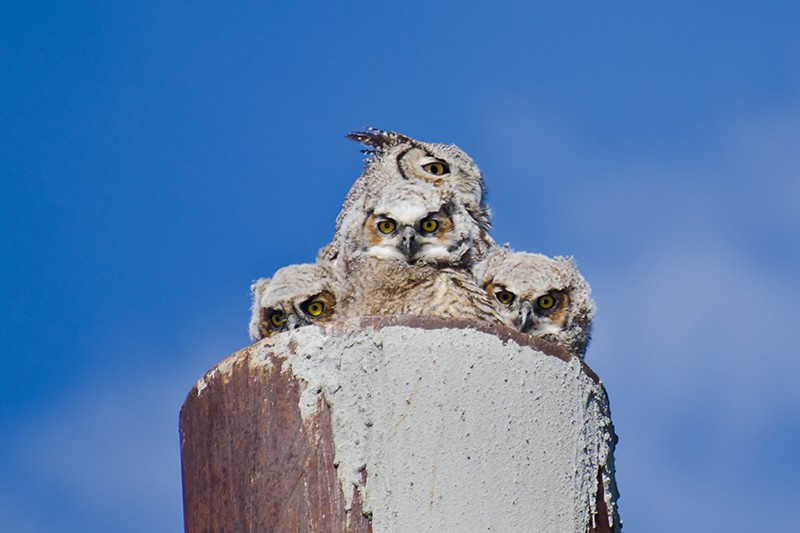
Why Baby Birds Are Highly Sensitive to Loud Sounds
Many birds have supersight. The American bald eagle has 20/4 or 20/5 vision and can spot prey the size of a rabbit from up to 3 miles away.
Humans, however, have a limited ability to only see the broader horizon at that distance without any finer detail.
Baby birds don’t have that kind of eyesight, whether they are hatchlings or nestlings. However, a baby bird has excellent sensitivity to sound, irrespective of loudness.
Interestingly, baby birds from certain species can hear sounds even before hatching.
Studies conducted in Australia and Spain reveal that the breeding adults of some avian species communicate with their unhatched progeny using sound.
These newborns can hear the sounds or calls of their parents, usually the mother, and respond using similar notes after hatching.
This phenomenon is similar to how an unborn human baby responds to sounds while still being in the uterus or womb.
And birds have a better audio processing power than people, so a hatchling or nestling is likely to be more sensitive to sounds that humans consider to be loud.
Birds Have Better Sensitivity to Sounds at Lower Decibels Than Humans
Like humans, most birds aren’t sensitive to infrasonic or ultrasonic frequencies.
Those ranges aren’t an issue regarding sound levels because the context is about sonic frequencies, normally referred to as sound or the audible range for Homo sapiens.
The loudness of sonic frequencies is measured in decibels. Loudness is also a subjective issue. What you may consider being loud might not be so for another person.
Likewise, adult and baby birds perceive loudness in their distinct way.
A siren producing 120 dB of sound pressure level might be very loud to you, but baby birds are more than sensitive to this level of loudness.
Most baby birds are likely to be petrified at 120 dB.
Baby birds of most species are sensitive to sounds as quiet as 0 dB to 10 dB in the 1 kHz to 5 kHz frequency range.
For context, 10 dB is the loudness of normal breathing. Therefore, what humans perceive as mildly loud is literally screaming, screeching, or shrieking for baby birds.
Adult and Baby Birds Hear Sounds at a Higher Resolution Than People
People can hear and process sounds when the duration is at least ~500 milliseconds.
If a sound has a shorter duration, it must be loud enough for the human brain to process and recognize it.
This reality applies to the entire audible range or all sonic frequencies.
Birds, whether adults or babies, can process sounds at a much faster rate or higher resolution.
Many birds can process audio notes with a duration as short as 3 milliseconds, but some species can process notes lasting barely 1 millisecond.
This amazing prowess is why songbirds can recognize distinct notes during courtship, which may appear as nondescript avian calls to human ears.
Since baby birds have a much better resolution or temporal processing of acoustic stimuli, they are highly sensitive to loud sounds.
Birds Have a Shorter Frequency Range But Greater Hearing Sensibility
Humans can hear sounds between 20 Hz and 20 kHz. Most birds aren’t sensitive to frequencies beyond 10 kHz, except doves, owls, sparrows, and a few other species.
Pigeons can recognize sounds below 20 Hz, such as infrasonic frequency or infrasound.
While birds have a shorter frequency range than humans, almost all avian species have a much greater hearing sensibility.
This attribute is mainly due to higher resolutions or faster processing speeds of audio. Also, adaptability and evolution have a significant role in auditory sensibility.
Thus, baby birds are more sensitive to loud sounds than humans, whether an adult or an infant.
Loud Sounds Can Have Adverse Effects on Baby Birds
Loud sounds or pervasive noise and light pollution affect many birds. Wild birds with a breeding and resident forest range are more sensitive to sound.
However, species in urban areas and landscapes populated by people have adapted to live with the omnipresent sounds.
Baby birds are expected to react to loud sounds with their screams and screeches.
But the calls aren’t the only evident signs of their discomfort or sensitivity.
Like adults, baby birds experience significant hormonal changes due to the stress caused by loud and persistent sounds.
Studies have shown that both adult and baby birds have abnormally low levels of corticosterone in noisy environments or when there is a source of persistent and loud noise nearby.
The main glucocorticoid in birds is corticosterone which regulates energy intake, mobilization, and other processes.
The corticosterone levels should have been higher in noisy settings because the adult and baby birds are stressed.
But that’s not the case because both adult and baby birds adapt to develop a lower baseline of the stress hormone to survive normally, much like a self-defense mechanism.
Adult or Baby Birds Don’t Suffer From Hearing Loss Like Humans
While adult and baby birds are more sensitive to loud sounds than humans, they don’t lose their hearing ability because their hair cells regenerate.
Birds may lose their lucid hearing ability for a while due to trauma, but the sensory receptors in the inner ears aren’t permanently damaged.
That said, if you are in a noisy area or there are persistent loud sounds in your house, you may not have a diverse avian community around your backyard or garden feeders.
Moreover, if you want to protect pets or rescue baby birds from loud sounds, get some padding for their nests.
You don’t need anything fancy like acoustic panels that would only reduce echo or reverberation unless you spend a lot of money.
Something simple like AA Plus Shop 100% Natural Wheat Straw Grass (available on Amazon.com) may suffice to absorb much of the loud ambient sound in a room or your house.
Sources
- National Institutes of Health: Do We Hear What Birds Hear in Birdsong?
- Proceedings of the National Academy of Sciences of the United States of America: Chronic Anthropogenic Noise Disrupts Glucocorticoid Signaling and Has Multiple Effects on Fitness in an Avian Community
- Stanford Medicine: Birds Never Go Deaf, But Why Do Humans?