
A flock of birds, ever-changing in number, captures the eyes of onlookers. Observing the birds taking flight in unison reveals nature’s impressive coordination. How many birds are in a flock?
The number of birds in a flock varies depending on the species, habitat, and time of year. Some species, like geese or starlings, can form flocks of thousands, while others, like owls or eagles, tend to be solitary or in small groups. During breeding season, birds may form smaller flocks or pairs.
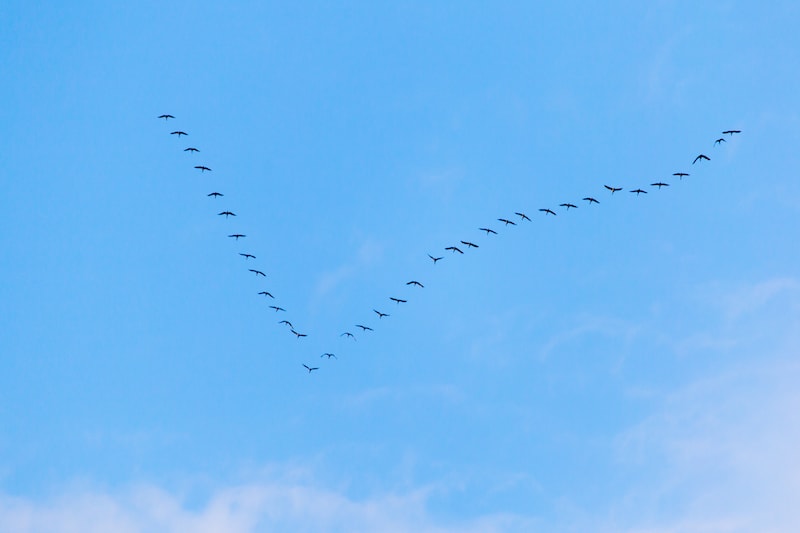
Defining a Flock
Single Species Flocks
A flock is a group of birds congregating and flying together. They can be categorized into single species and mixed flocks.
In a single species flock, the group consists of only one type of bird. These flocks form for various reasons, such as feeding, mating, or migrating.
They often display coordinated behaviors, which play a crucial role in their survival and efficiency.
For instance, starling flocks display scale-free correlations.
Starlings synchronize their movements by responding to their neighbors’ actions, which helps them avoid predators and minimize energy consumption.
The size of single species flocks varies greatly, depending on factors like food availability, season, and habitat.
Mixed Flocks
Mixed flocks, on the other hand, comprise different bird species that come together under particular circumstances.
A common reason for mixed flocks is foraging, where various species benefit from each other’s unique abilities to locate or access food resources.
These flocks can be classified based on their leaders, who initiate movements and dictate the flock’s direction.
An example of mixed flocks can be seen in forest birds, whose diverse compositions can play roles in their success as a group.
The varying species-specific roles allow mixed flocks to flourish under different environmental conditions.
In such flocks, birds show adaptations to maximize their efficiency in finding food and avoiding threats.
Formation and Behavior
Murmuration
Birds, particularly starlings, display an aerial spectacle called murmuration during migration or when gathering in large numbers.
These coordinated and synchronized flight patterns offer several benefits to the birds. Murmurations can confuse and deter predators, increasing flock survival.
They also aid in foraging, as birds can easily follow each other to locate food sources.
The thermoregulatory benefits of flocking can help conserve energy during challenging environmental conditions.
Mobbing
Mobbing is another behavior exhibited by bird flocks. Often seen in migratory bird species, this tactic involves a group of smaller birds harassing a larger predator.
Mobbing allows birds to protect their territory, offspring, or food resources from intruders.
Though risky, this collective behavior improves the chances of survival and reproductive success.
Flight patterns in murmurations and mobbing:
- Synchronization
- Confusing predators
- Enhancing foraging
- Protecting resources
- Function of Flocking
Foraging
Birds flock together for various reasons. Foraging is one of the key functions of flocking.
When birds gather in flocks, they improve their chances of finding food. The larger the flock, the more eyes are on the lookout for food resources.
This collective effort enables them to cover larger areas, reducing the search time and energy expenditure for each individual bird.
The foraging behavior in flocks may vary depending on bird species and the environmental conditions.
However, the general principle remains that when birds operate together, they share information about food resources and help each other.
This results in better foraging efficiency for the entire flock.
Predator Avoidance
Another vital aspect of flocking is predator avoidance.
Flocking allows birds to reduce the individual’s risk of predation by distributing the responsibility of vigilance among multiple individuals.
In large flocks, each bird becomes relatively safer because the probability of it being targeted by a predator decreases.
While at the same time, the likelihood of detecting a predator increases due to numerous eyes and ears.
In species with diverse flock densities, the risk of predation can also vary.
For example, groups of birds with different molting patterns can take turns vigilantly watching for predators while their counterparts feed or rest.
This cooperative effort further enhances predator avoidance.
In a neotropical rainforest, foraging birds were observed to engage in different flock types with varying degrees of effectiveness in avoiding predators.
Flocks Throughout the Year
Breeding Season
During the breeding season, birds gather in flocks to find mates and reproduce.
This is a critical time for species’ survival, as it ensures the continuation of their lineage.
- Social behavior increases
- Mixed-species flocks may occur
- High energy demands for reproduction
In some cases, birds form mixed-species flocks, enhancing communication and foraging capabilities.
Winter
After the breeding season, winter arrives with its challenges. Birds adapt by:
- Migrating
- Changing diets
- Joining larger flocks
During the cold months, waterfowl often form close-knit flocks, migrating together to warmer climates for better access to food.
Winter flocks face limited food sources, needing to:
- Forage more efficiently
- Locate scarce resources
- Adapt to different diets
With regard to molt, birds also experience changes in their feathers during winter. The molt helps birds keep warm and maintain flight.
The process takes energy, especially during this challenging season.
| Winter Challenges | Adaptation |
|---|---|
| Cold temperatures | Molt |
| Limited food | Foraging in flocks |
| Predation | Group vigilance |
Flocks during winter can offer protection, help find resources, and provide support against challenging weather conditions.
Observing these winter flocks gives crucial insights into bird adaptation and survival strategies.
Counting Birds in a Flock
Key Techniques
Bird counting requires skill and practice. Observers often employ diverse techniques, depending on the bird species and flock size.
- Direct Count: Applicable for smaller flocks, observers count each bird individually.
- Photographic Count: For larger flocks, taking photographs and later counting birds in the images is more efficient. Photography has been used in counting roosting birds.
- Group Estimation: Observers section larger flocks into smaller, more manageable chunks and then estimate the numbers.
Estimation Practices
When estimating bird numbers, consider these factors for accuracy:
- Flight flocks: Be conservative in counting birds moving in flight.
- Bird species: Familiarize yourself with different plumages to identify and count species correctly.
- Position and altitude: Finding a vantage point to count birds helps to avoid under or over-estimating.
Simulation or counting experiments can be carried out to understand the estimation errors, as demonstrated in errors in large-scale shorebird counts.
Using eBird
eBird is a valuable tool for birdwatchers to share sightings and collectively gather data. To submit an accurate eBird checklist:
- Keep a detailed count of your observations on a notepad.
- Visit birding sites at different times to increase encounter probabilities.
- Double-check your observations and use conservative counting.
Following these guidelines will ensure that bird counting remains accurate and contributes to valuable data on bird populations and their habits.