
The Red-Winged Blackbird, a charismatic member of the Icterid family, frequents marshes and wetlands across North America.
With its striking red and yellow shoulder patches and melodic call, birders and nature enthusiasts alike find joy in observing these remarkable aviators.
These birds are highly adaptable and can be found in a variety of habitats, from wetlands and grasslands to agricultural fields and urban parks.
In addition to their striking appearance and beautiful songs, Red-Winged Blackbirds play an important ecological role as seed dispersers and insect predators.
Red-Winged Blackbird Identification
Male
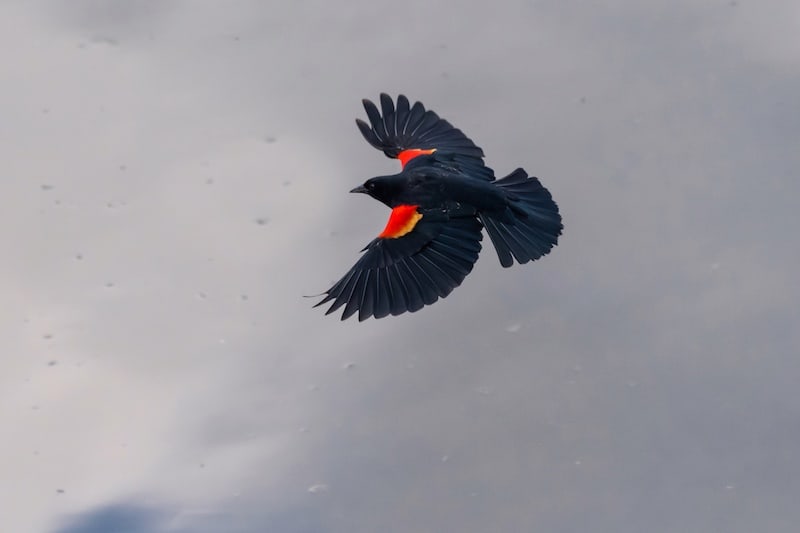
The male Red-winged Blackbird, notable for its glossy black plumage, flaunts a striking display of color on its shoulders.
Epitomized by vibrant red patches edged by a thin yellow line, these shoulder tufts, or epaulets, serve as a primary identifier for the species.
To ensure accuracy, birders ought to observe the male’s entire attire, paying heed to secondary features.
One such attribute is their bill, which is a sharp, conical shape contributing to their assertive appearance.
When differentiating between species, it is crucial to note that the Red-winged Blackbird can resemble the Tricolored Blackbird.
While similarities abound, the latter can be distinguished by its darker epaulets and contrasting white-centered feathers.
Female
Conversely, female Red-winged Blackbirds showcase a distinct color pattern, deviating from their male counterparts.
Exhibiting a primarily brown plumage, these females are adorned with streaks of buff or white, granting a subtle mystique.
They brandish a pale eyebrow accentuating their lores and throat.
In contrast to males, females possess a more subtle bill, lacking the fierce sharpness found in their counterparts.
Habitat and Distribution
Red-winged blackbirds, occupying most of North America, favor wetlands for breeding and nesting.
Their aptitude for wet habitats signifies the importance of preserving such areas. As climate change affects water and vegetation, blackbirds adapt yet face challenges.
The bird’s inclination for marshy habitats yields unique nesting selections, often building nests atop cattails and other marsh vegetation.
The intricacies of these habitats provide safety from potential predators.
Though typically found near water, red-winged blackbirds also reside in upland grasslands.
However, research reveals that upland habitats may serve as lesser-quality breeding grounds compared to marshy environments.
Climate change presents emerging difficulties:
- A loss of wetland habitats due to water level fluctuations or droughts.
- The introduction of invasive plant species can alter vegetation composition.
- Altered breeding patterns and migration timelines in response to shifting climate.
Adaptation is a characteristic of red-winged blackbirds as they inhabit non-marshy areas such as:
- Agricultural fields.
- Scrublands.
- Woodlands.
Breeding and Nesting
Nest Building
Red-winged Blackbirds (Agelaius phoeniceus) are known for their distinct nesting habits. They often build cup-shaped nests within cattail marshes, shrubs, and trees.
The construction process involves weaving grasses, twigs, and wet leaves, speeding up the nest’s solidification.
These materials help create a solid foundation as mud serves as a binding agent, strengthening the overall structure.
Eggs and Hatching
During the breeding season, female Red-winged Blackbirds lay a clutch of 3-4 eggs in their well-constructed nests.
The eggs are pale blue-green with dark markings, contributing to their easy identification.
After a period of approximately 11-14 days, the eggs hatch, bringing forth the next generation of these fascinating birds.
These young chicks remain in the nest for an additional 10-14 days, cared for by both parents.
They learn vital survival skills, such as foraging for food and defending their territory, from their family members.
This nurturing environment allows the Red-winged Blackbirds to flourish and expand their territory.
Breeding season not only sees the hatching of new chicks but also highlights the male Red-winged Blackbirds’ polygynous behavior.
They establish and defend territories, attracting multiple females who are enticed by the males’ flashy red patches on their wings and the contrast against their black feathers.
Migration and Food Habits
Red-winged Blackbirds, a common sight in wetlands, exhibit fascinating migration patterns. They migrate south in the winter, returning north in spring when temperatures rise.
Northern populations tend to be more migratory, while southern ones often reside year-round in their territories.
Knowledge of migration patterns is essential for birders to track these birds and observe their behavior.
When it comes to food habits, Red-winged Blackbirds are not picky. They have a diverse diet, primarily consisting of seeds and insects.
These birds readily forage in marshes, fields, and other habitats rich in plant life. Here is a list of some food sources commonly consumed by Red-winged Blackbirds:
- Insects: Such as beetles, caterpillars, and ants
- Seeds: From grasses, weeds, and other plants
- Agricultural crops: Corn, wheat, and sunflower seeds
During times of food scarcity, these blackbirds can be seen foraging in mixed flocks with other bird species such as cowbirds and grackles.
This behavior allows them to reduce competition and find food more efficiently.
Birders should keep an eye on such mixed flocks to spot Red-winged Blackbirds as they join forces with other species to find sustenance.
While observing these birds in action, it is crucial to consider their unique flying patterns.
Red-winged Blackbirds are agile fliers and often make rapid, direct flights with swift wingbeats.
This distinguishes them from other blackbird species and aids birders in accurate identification.
Predators and Survival Strategies
Red-winged blackbirds face various predators, each demanding different survival tactics.
Awareness of these adversaries lets birdwatchers appreciate the bird’s defensive prowess.
A common predator, the American crow, feeds on eggs and nestlings. Red-winged blackbirds evade these larger birds by:
- Building nests in dense vegetation
- Staying hidden when a crow is near
- Attacking crows in flight to divert them
Ground-based predators like raccoons and snakes challenge the red-winged blackbird differently. They show:
- Nest placement in taller vegetation
- Utilizing grassy materials to blend in
- Aggressively mobbing invaders near the nest
Birdwatchers keen on identifying red-winged blackbirds should look for field marks that help differentiate them from other birds. These marks include:
- Males: Red shoulder patch with a yellow streak
- Females: Streaked brown plumage resembling a large sparrow
Key features and characteristics of the Red-Winged Blackbird:
| Feature | Male | Female |
|---|---|---|
| Size | 17-23 cm | 16-21 cm |
| Wingspan | 31-41 cm | 29-36 cm |
| Weight | 32-77 g | 29-67 g |
| Plumage | Glossy black with red and yellow shoulder patches | Brown and black with streaked underparts |
| Habitat | Wetlands, marshes, and grasslands | Agricultural fields, meadows, and urban parks |
| Diet | Seeds, insects, and small invertebrates | Seeds, insects, and small invertebrates |
| Nesting | Builds nests in cattails and other tall vegetation | Builds nests in cattails and other tall vegetation |
| Breeding | Polygynous, with males defending territories and mating with multiple females | Monogamous, with males and females forming pair bonds |
| Migration | Short-distance, with some populations remaining resident year-round | Long-distance, with some populations traveling thousands of miles to wintering grounds in the southern United States and Mexico |
Resilient and resourceful, red-winged blackbirds embody nature’s adaptation amidst adversity.
Red-Winged Blackbird Conservation
Icteridae family members, red-winged blackbirds dwell in reeds and wetlands.
The bird shares similarities with sparrows but stands apart with striking red and yellow shoulders.
Conservation strategies prioritize habitat protection due to climate change threats.
Habitat Expansion
Wetland conservation is crucial. Climate change alters environments and affects bird populations. Efforts for habitat expansion include:
- Restoring marshes and swamps
- Creating artificial wetlands
- Preserving open farmlands
These actions benefit not only red-winged blackbirds but other species as well.
Breeding Grounds and Nesting Sites
Encouraging habitat growth requires consideration of breeding grounds and nesting sites. Nesting success is influenced by availability and quality.
In the breeding season:
| Region | Breeding Time |
|---|---|
| Northern United States | Early April to mid-June |
| Southern United States | Early February to April |
| Central America and Cuba | November to April |
Managing reeds and cattails in wetland areas is essential.
Public Awareness and Birding Ethics
Educating the public and promoting birding ethics is a vital part of conservation. Guidelines to follow include:
- Do not disturb nesting areas
- Keep a safe distance from birds
- Minimize noise and use of flash photography
- Respect private property and protected lands
As birding enthusiasts, our actions impact the species we admire.
By combining habitat expansion, nesting improvement, and responsible birding, the red-winged blackbird conservation efforts can be effective and long-lasting.