
Last updated on May 25th, 2023 at 11:24 pm
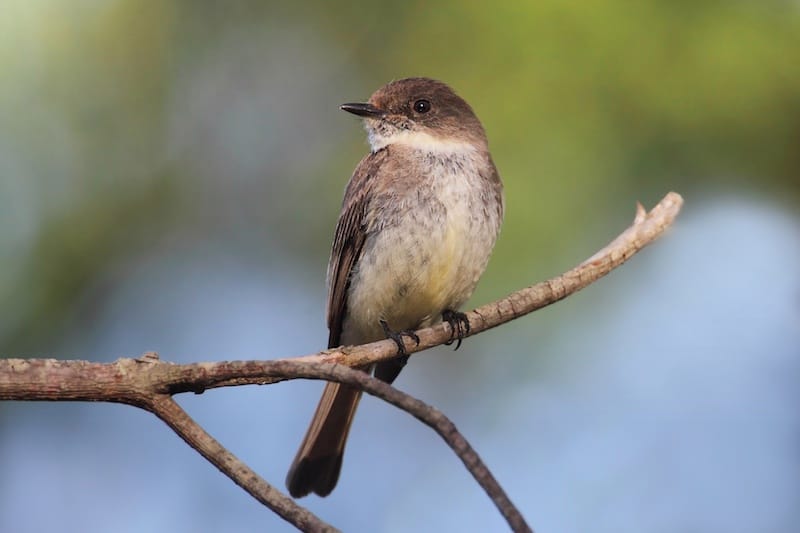
The Eastern Phoebe is a plump songbird with a knack for catching insects. This charming species has a brownish-gray top and white underparts.
It is among the earliest of migrants, signaling spring’s arrival as it nests around buildings and bridges in eastern North America. The Eastern Phoebe is a species worth getting to know.
Identification and Appearance
Size and Shape
Eastern Phoebes are medium-sized birds with a length of about 7 inches. They possess a slightly large head, relatively short wings, and a medium-length tail.
These features give them a somewhat stocky appearance.
Color and Markings
These birds exhibit a brownish-gray color on their upper parts, with white underparts. Their breast shows a dusky wash, and their head sports dark upperparts.
The Eastern Phoebe lacks an eye ring and wing bars, setting them apart from similar species in eastern North America.
Wingspan and Tail
Eastern Phoebes have a wingspan that ranges from 10.5 to 11 inches.
Their medium-length tail often wags when perching, which can be a distinguishing characteristic of their behavior.
Habitat and Distribution
Geographical Range
Eastern Phoebes inhabit a vast region spreading across eastern North America. These birds breed as far north as Alberta and extend southward throughout Iowa.
During winter, they migrate to southern Mexico.
Migration Patterns
These small creatures are partially migratory. Some remain in the northern parts of their range throughout winter, whereas others travel south.
Migration is shaped by seasonal changes, ensuring access to an ample food supply.
Woodland Edges and Streams
Eastern Phoebes thrive in a variety of habitats, though they show a preference for woodland edges and areas near streams.
They frequent open woodland, farmland, and suburbs, often in proximity to water sources.
Access to these watery terrains provides them with a prime hunting ground for insects and offers protection from potential predators.
Nesting Locations
Nesting is an important aspect of Eastern Phoebes’ lives. Several factors come into play when selecting a spot.
They often choose sheltered locations such as the undersides of bridges, eaves of buildings, or ledges on cliffs and rock faces.
These sites provide cover from the elements and safety from many predators. Successful nesting contributes to the overall population stability and growth.
Below is a quick summary to more easily identify an Eastern Phoebe:
| Feature | Description |
|---|---|
| Size | Medium-sized songbird, about 6-7 inches long |
| Color | Brownish-gray on top, white underparts, with a dusky wash on the sides of its breast and dark upperparts on its head |
| Bill | Black, thin and straight, about 0.5-0.6 inches long |
| Wings | Relatively short and broad, with duller wingbars than Empidonax flycatchers |
| Tail | Relatively long, with a distinctive tail-wagging behavior |
| Habitat | Prefers open woodland, farmland, and suburban areas with scattered trees and shrubs |
| Range | Breeds in eastern North America, from Canada to the Gulf of Mexico, and winters as far south as southern Mexico |
| Song | Clear, whistled “fee-bee” or “phoebe” notes, often repeated in quick succession |
Diet and Feeding Behavior
Insects and Other Prey
The Eastern Phoebe is an adept hunter, primarily feeding on insects.
Its diet consists of a variety of small invertebrates, such as wasps, bees, beetles, flies, grasshoppers, and true bugs.
Additionally, this resourceful hunter consumes spiders, ticks, and millipedes, which provide valuable nutrients for the bird.
Eastern Phoebes are known for their distinctive feeding behavior. They patiently perch on low branches, scanning for prey from a vantage point.
Once a target is spotted, the bird swiftly darts out, seizing the insect mid-flight and returning to its perch.
This energy-efficient hunting style allows the Phoebe to maintain its rigorous feeding schedule while expending minimal effort.
Fruits and Berries
While insects make up the bulk of the Eastern Phoebe’s diet, they also partake in fruits and berries, particularly during cooler months.
These small fruits, such as hackberries, hawthorn, and dogwoods, provide crucial sustenance when insects become scarce.
Thus allowing the bird to maintain its energy levels throughout the year.
In addition to serving as a valuable fallback for the Eastern Phoebe, fruits and berries also benefit the surrounding ecosystem.
The bird helps to disperse seeds through its foraging habits, ensuring the propagation of various plant species and contributing to biodiversity in its native habitats.
Breeding and Nesting
Nests and Nest Structure
Eastern Phoebes, part of the Tyrant Flycatchers family, start their breeding season in spring.
These returning migrants skillfully construct their nests under eaves, bridges, or other overhangs using an array of materials.
The foundation primarily consists of grass and moss, which are then held together with mud.
For lining, they employ various other materials such as hair, rootlets, and fine grass, resulting in a snug, cup-shaped nest.
Eggs and Incubation
During each breeding season, Phoebes lay their first clutch of eggs in March or April. The pure white eggs, numbering 4-5, occasionally feature reddish-brown dots.
The female Phoebe shoulders the sole responsibility of incubating the eggs, maintaining the warmth required for their development.
Incubation lasts approximately 16 days.
Nestlings and Broods
Once hatched, both parents play a crucial role in nurturing the nestlings, feeding them diligently.
The young birds typically fledge after 16 days of hatching, leaving the nest to explore their surroundings.
Eastern Phoebes manage to raise two broods per year, exhibiting their efficient and tenacious life history.
Behavior and Life History
Calls and Songs
The Eastern Phoebe, a member of the Tyrannidae family, is known for its distinctive fee-bee song.
This songbird has a call that is higher-pitched than that of its close relatives.
During summer months, Eastern Phoebes perch atop branches to attract mates through their patterned singing.
Tail Wagging and Movement
A noticeable behavior of the Eastern Phoebe is its tail-wagging movement. This bird often wags its tail upon landing on a perch or when hunting insects.
Short flights and swift movements characterize the Eastern Phoebe’s hunting and feeding behavior.
Perches and Protected Nooks
Eastern Phoebes have a penchant for perches and protected nooks near water sources, as water offers a bountiful supply of insects for their diet.
They favor old buildings, bridges, and overhangs for nesting locations, providing easy observation by birdwatchers.
Males, returning from wintering grounds as far as Mexico, scout for ideal nesting places near water and protected structures.
Phoebes are one of the earliest migrants to return in spring, signaling the arrival of warmer seasons.
The bird’s seemingly tame disposition allows it to coexist easily with humans, making it a favorite among observers.
Eastern Phoebe and Other Birds
Comparison to Other Flycatchers
Eastern Phoebe (Sayornis Phoebe) is a flycatcher, small and drab. It is brownish-gray with dark gray-brown upperparts and slightly darker wings and tail.
Like its relatives, tail-wagging is its trademark.
Among flycatchers, Eastern Wood-Pewee and Willow Flycatcher are similar, but Phoebe stands out in early migration and fondness of human dwelling.
Black Phoebe and Say’s Phoebe are Western cousins. Black Phoebe is darker, wearing sooty black and white. Say’s Phoebe, pale gray and cinnamon color.
They share tail-wagging habit but choose different habitats.
Relationship with Chickadees and Titmice
The Eastern Phoebe is a favorite among birdwatchers. They dwell near farms, bridges, and neighborhoods.
They do not shy from humans. The Black-capped Chickadee and Tufted Titmouse, inhabitants of mixed woods, share this trait.
Birds join mixed-species flocks in non-breeding seasons. John James Audubon observed that Eastern Phoebe forages near Black-capped Chickadees and Tufted Titmice.
Photo Gallery and Identification Resources
Eastern Phoebe, a medium-sized flycatcher, presents a drab appearance. Identification depends on its color and constant tail-wagging.
Brownish above, pale below, the bird often exhibits a light yellowish wash on the belly.
Reliably identifying this species further relies on observing the duller wingbars that distinguish it from Empidonax flycatchers.
Several resources allow birdwatchers to better understand the Eastern Phoebe.
One notable resource, the All About Birds site by the Cornell Lab of Ornithology, provides comprehensive identification information.
The site also features a helpful Eastern Phoebe Photo Gallery that complements the identification process.
Visually identifying an Eastern Phoebe calls for observing its shape. It holds a plump songbird appearance and a large, often peaked head.
Grayish-brown above, the bird’s head appears darker, with a whitish color on its underside.
Audubon Field Guide also presents an informative profile on the Eastern Phoebe.
Birdwatchers can use this resource to learn about its distinguishing characteristics and migration patterns.
In summary, the Eastern Phoebe’s unique traits, including coloration, tail-wagging, and head shape, aid in its identification.
Drawing from resources such as photo galleries and field guides proves invaluable for learning more about this charming bird.