
Last updated on April 17th, 2022 at 11:55 pm
When you’re purchasing equipment for wildlife and bird photography, you must do your research to ensure that you’re not paying too much. Finding out the best focal length for a wildlife photography lens will keep you from spending too much on a lens with more zoom than you need.
A 300mm lens is enough for wildlife and bird photography. With a lens of this focal length, you’ll be able to capture detail from a distance, even when focusing on small subjects like songbirds. Look for a lens with a fast speed to make sure that you can capture a moving subject without blur.
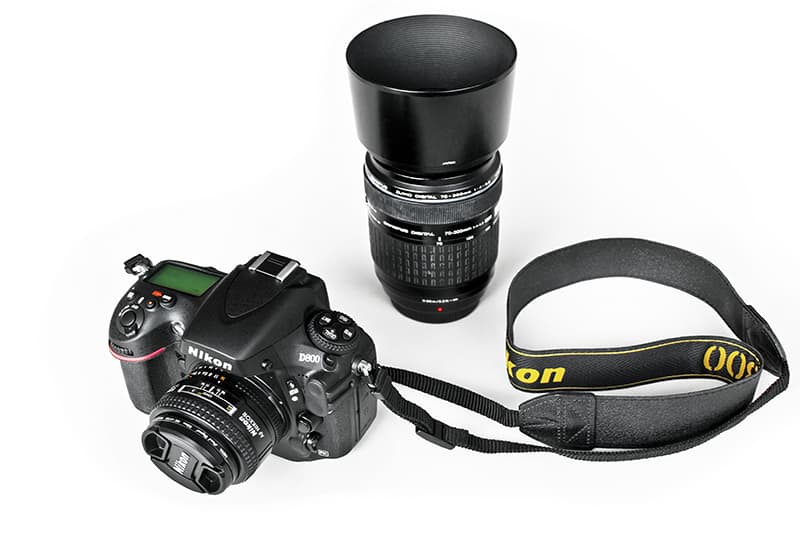
Finding the Right Lens for Wildlife and Bird Photography
There are certain camera settings you’ll find especially useful when it comes to wildlife photography.
When photographing birds, in particular, you’ll need a camera and lens with plenty of zoom, which is more than you’d need for photographing large game.
Focal Length/Zoom
The best focal length for wildlife photography is 300mm if you’re using an APS-C DSLR, but you’ll need 400mm if you’re using a full-frame DSLR or a 35mm SLR.
However, you can do with less zoom and a shorter focal length if you’re able to get close to the animals you’re photographing or are photographing larger animals.
In these cases, 70-200mm of zoom can work.
Lens Speed
The faster your shutter speed is, the faster lens you’ll need.
These settings are especially important when you’re trying to capture movement or photograph a bird that could quickly move out of frame.
Keep in mind, however, that faster lenses are typically more expensive and bulkier, so you’ll have tradeoffs.
Weight
Depending on where you want to take your lens, weight may be more or less a factor.
If you plan to hike a distance to get to a shooting location, you might consider getting a slimmer, less weighty lens.
This will prevent fatigue and make traveling with it easier.
Keep in mind that more lightweight lenses also tend to be less powerful.
Glass Type
Different lenses have different kinds of glass, and the type will greatly impact the performance and price of the lens.
Fluorite lenses are most common in top-end cameras, whereas mid-range lenses are more likely to have UD and ED elements.
The right one for you depends on whether you’d rather go with a professional-grade lens or a budget-friendly option.
Durability
Durability is also a key component of a good wildlife photography lens.
You’re likely to take the lens outside in all kinds of weather, so be prepared to have your lens deal with heat, cold, rain, and any number of other weather conditions.
Your equipment should resist absorbing dust and be shockproof and waterproof.
Best Wildlife and Bird Photography Lenses 2021
Finding the right lens for your camera is as important as finding the right camera itself.
A good lens from Amazon.com offers good clarity, accuracy, and magnification without being too unwieldy. Here are some of the better lenses.
NIKON AF-S FX 300MM F/4E PF ED VR
This 300mm lens is ideal for all Nikon DSLR cameras.
It’s well-suited for wildlife photography, having enough zoom to get great detail on small, moving birds without being too bulky.
This lens has a silent wave motor for fast autofocusing while allowing a manual override.
It also comes with vibration reduction technology to provide a more stable image.
Canon EF 100-400m f/4.5-5.6L IS II USM
This 100-400mm lens has more zoom than you need in most cases but is such a nice lens overall that you might consider the investment.
It is durable and has a twisting control ring that you can use to adjust the zoom and prevent zoom slip.
It provides clear and accurate image quality and is highly versatile, appropriate for all kinds of wildlife and bird photography.
Sigma 150-600mm 5-6.3 Contemporary Lens
This 150-600mm lens is great for beginner bird photographers because it has a decent focal length, is easy to use, and isn’t as expensive as other options.
This lens is also great because it’s compatible with so many kinds of cameras and lenses.
Nikon, Canon, and Sony products are all compatible with this lens.
Panasonic LUMIX G II Vario Lens
This 100-300mm lens has just enough zoom for bird and wildlife photography and comes at a budget price compared to other lenses.
This lens is lightweight and easy to pack, ideal for traveling photographers and hikers. It also provides vibrant images with color accuracy and clarity.
Can You Use a Teleconverter With a 300mm Lens?
You can use a teleconverter with a 300mm lens, which makes it work as if it were a 600mm lens.
It is often at a lower cost than a lens of that focal length would normally cost.
This tool attaches between the camera’s body and the lens, increasing the lens’s focal length 1.4x-2x.
That said, a teleconverter has several drawbacks.
The first is that teleconverters keep some light from reaching the image sensor or film, requiring long shutter speeds or higher ISOs to get a clear picture.
Still, it can lead to dimmer pictures and difficulty focusing.
Teleconverters may also impact autofocusing performance, sometimes making it so that you cannot autofocus at all.
This is important to keep in mind, especially if you have a lens without an anti-zoom slip feature.
Note that teleconverters come in a range of grades and qualities.
And using a lower-quality teleconverter will decrease the quality of the pictures just as though you had a lower-quality lens.
The Extender EF 1.4x III Lens from Amazon.com makes for a great choice, offering a 1.4x focal length extension and excellent performance.
This teleconverter makes sure that the camera body, lens, and extension work seamlessly together to prevent ghosting and ensure high-quality photos.
Note that this extender is made for Canon cameras only.
Whenever you buy a teleconverter, check first that it’s compatible with your camera.
Some teleconverters are compatible with just one lens and camera manufacturer, while others are compatible with a range.