
A map and compass are key to hiking and birding safely, and if you know how to use them, you can find your way even if you go off-trail.
But what about a sighting compass? Is that a necessary tool, or is it overkill?
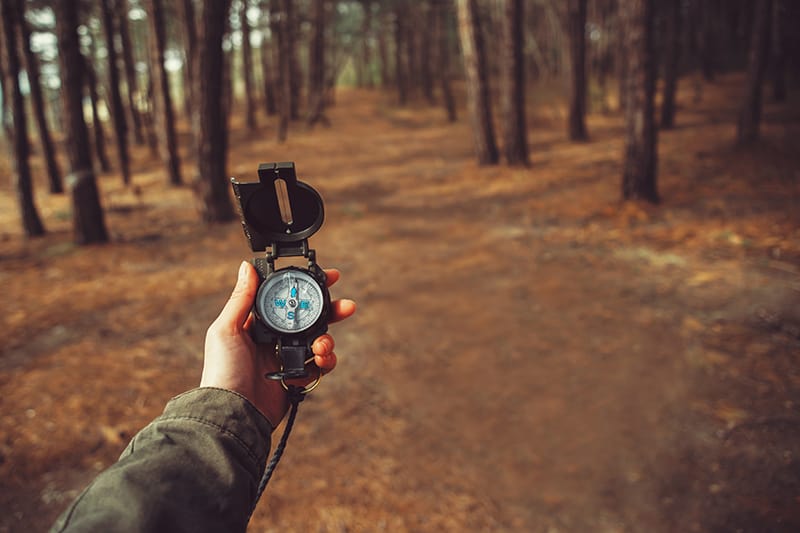
You might need a sighting compass while hiking. Any compass can keep you from losing your way if you go off-trail, but a sighting compass makes the process of navigating even simpler. With a sighting compass, you can see your target while you’re taking measurements.
Why a Sighting Compass for Hiking Is a Good Idea
Any time you’re going hiking or birding, it’s a good idea to bring a compass, especially if you’re going off-trail.
Sighting compasses have the bonus of allowing you to make eye contact with your target while getting a reading, which makes it easier to orienteer.
Orienteering isn’t necessarily a part of hiking, but it’s still a good idea to know how to do it.
This is especially true if you were headed out into a remote area searching for that rare Ivory-billed woodpecker locals have told you about.
Getting lost while hiking can be potentially deadly and create an uncomfortable inconvenience at best.
What Is a Sighting Compass?
A sighting compass is a compass that provides you with a direct line of sight in any direction.
This allows you to line up the needle of your compass with your target more easily.
If you’re going to purchase a compass for hiking, you may as well invest in a sighting compass to make your navigation experience simpler and more effective.
A sighting compass usually has a mirror to reflect an image of the compass while you’re looking in the direction of your target.
You should use a sighting compass when you want more precise navigation.
It also allows you to see the angle of inclination ahead of you, which comes in handy when you’re trying to read a topographic map.
Some sighting compasses have a magnifying optic that allows you to get a reading off the edge of a disk instead of using a needle.
Either kind of sighting compass can give precise readings and be a reliable tool for birders.
Reasons To Bring a Sighting Compass While Hiking
There are many reasons to bring a sighting compass while hiking or bird watching, including the following:
- It’ll help you make sense of your map. Having a topographic map is only helpful if you know how to read it and you know how to position yourself on it. A sighting compass makes this process easier and simpler.
- It’ll help you get back to the trail. If you need to head off the trail to relieve yourself or any other reason, take note of the direction you’re heading and then use your compass to get back.
- It doesn’t rely on batteries. Many navigation tools rely on a power source to function, and when the batteries die, you’re left without a critical tool. A simple sighting compass doesn’t rely on batteries, so you can be sure it’ll keep working throughout your hike or trip.
- It won’t break easily. Most sighting compasses are sturdy and built to last. Your compass won’t break easily if you purchase a military or professional-grade compass.
How To Use a Sighting Compass
When you’re pulling out your sighting compass, first decide if you want to use it with a map or with a visual landmark.
Using a Sighting Compass with a Map
To use a sighting compass with a map, follow these directions:
- Place your compass and map on the ground.
- Mark your current position on the map.
- Mark your desired destination on the map.
- Draw a straight line between these two points.
- Line up your compass on the line so that the travel arrow is pointing in your travel direction.
- Twist the azimuth ring (the one with units of degrees) until the map’s north is oriented with the orienting arrow.
- Remove your compass from the map without changing the position of the azimuth ring.
- Turn in place until the orienting arrow and the red magnetic needle are in line.
Using a Sighting Compass by Sight
To use a sighting compass by sight, follow these directions:
- Point at your landmark with the travel arrow on the compass.
- Rotate your azimuth ring so the orienting arrow is in line with the red magnetic needle.
- Continue on your path, keeping the needle pointing in the same direction.
Keep in mind that the magnetic north on the compass isn’t the same as true north and that maps are oriented towards true north.
You can resolve this issue by considering the declination, or the difference between true north and magnetic north.
Most topographic maps will have a legend, including a guide towards finding the north.
The legend on a topographic map will show you two straight lines, with the true north line having a star on the top of it and magnetic north indicated as MN.
The declination is unique to the time and place you’re orienteering, so remember when choosing a map and planning a trip.
Very old maps will likely be inaccurate.
Where To Buy a Sighting Compass
You can buy a sighting compass online from The Compass Store or REI, or you can purchase one from Amazon, like the Cammenga Lensatic Compass.
This compass is the number one pick by TheDrive.com, with a rugged design resistant to shock, water, and sand, as well as extreme temperatures.
The Cammenga Lensatic Compass is a military-grade sighting compass used by government agencies and outdoor enthusiasts alike.
This is because it has a sight wire and magnifying lens for added precision. It can also lock in place to remain steady while in use.
The only downside to the Cammenga Lensatic Compass is that it’s difficult to use with a map.
Another option is the Sportneer Military Lensatic Sighting Compass, another professional-grade compass from Amazon that’s made to withstand the elements.
This compass glows in the dark and comes with a carrying pouch for ease of use.
However, it’s a bit heavy for backpacking, and it doesn’t work well in the extreme cold.