
Last updated on May 8th, 2022 at 11:42 pm
As you look out your back door, you imagine all the happy creatures dancing on your lawn. And then suddenly, during your daydream, you see a Cooper’s Hawk swing by.
Your delight turns to displeasure. You begin to grow concerned for your dear little Chickadees. Optimal bird feeder placement takes a bit of time and effort but is beneficial to both birds and yourself.
The best location for a bird feeder is one that is positioned with window reflection safety in mind, avoidant of easy predatory kills, and within eye view from where you can enjoy the meditative benefits of backyard bird watching.
Where To Position a Bird Feeder
Recently, as I was approaching the front of a house, I suddenly heard a buzzing sound. For the life of me, I thought maybe it was a wasp.
Then I jerked my head to the side and there was a hummingbird humming right by me. Greetings!
The owner of the house had placed a hummingbird feeder dangling from above the cemented doorway area entrance.
This got me thinking about best practices when placing a bird feeder.
Below are the three most important factors to keep in mind when positioning your bird feeders.
I. Window Strike Prevention
Window strikes kill up to one billion birds a year.
It is every backyard birder’s responsibility to do their part in contributing to conservation efforts and help bring this number down.
The last thing you want to see is a regular visitor, perhaps a Northern Cardinal, visit your feeder and then fatally smash into your storm door.
The best way to prevent such a common scenario is to place the bird feeder close, within three feet, to the reflected window.
You can also attach the bird feeder directly to the window.
Here’s why: If the bird were to swing around it would hit the window at a slight angle from close quarters.
Contrast this with placing a feeder more than three feet away from the window where the bird has plenty of wind-up speed to violently crash into it.
According to ornithologist Daniel Klem Jr., most window collision deaths occur when bird feeders are placed 15 – 30 feet away.
II. Cover Protection
Providing cover protects birds from predators, inclement weather and gives them a place to nest.
A good mixture of trees, shrubs, and hedges gives birds good hiding areas in the summer and protection from storms in the winter.
Nest boxes or birdhouses can encourage birds to stay near your home and raise their families.
The three main predators to look out for in any backyard are hawks, cats, and squirrels.
Hawks
Hawk attacks are a real thing. It is believed that the Cooper’s Hawk was saved from endangered species status due to the increased popularity of backyard bird feeding.
Providing cover for your birds helps prevent predatory bird attacks like that from a bird of prey.
If you have a hawk issue, take down all the feeders for a short time. The hawks will eventually find another food source.
If a pesky hawk still remains, contact an animal control officer or wildlife professional. Avoid using inhumane tactics.
You can also put cages around your current feeders, and consider buying them that way in the future if your area is heavily preyed upon.
Cats
In the USA, it is estimated cats kill up to 2.4 billion birds a year.
Unlike a bird of prey which actually uses the captured bird as a food source, a cat just leaves the bird left there for dead.
If you own a cat, it’s best to keep it in the house. If you do let your cat out of the house, consider buying a brightly colored bell collar such as the Bemix Reflective Cat Collar sold on Amazon.com.
These collars have a bell that helps alert the birds of a cat’s presence. An added benefit is that these collars are brightly colored.
Birds are attracted to bright colors and may potentially be visually alerted to the cat’s presence.
There has been evidence that cats can learn to silence the bell while on the hunt, so it’s safer to have the best of both worlds.
Squirrels
Squirrel attacks on backyard birds are fairly uncommon. It’s more likely that they will be a nuisance at your feeders and scare the birds away.
Avoid placing the bird feeder near tree branches where squirrels can easily jump onto the bird feeder.
What’s most important is to know how high a squirrel or cat can pounce and from which direction.
On average, squirrels and cats can jump five feet into the air.
Cats tend to hide nearby and ambush a bird from the bushes before pouncing towards their prey.
III. Bird Watching Benefits
You want to reap the meditative benefits of your backyard habitat so having bird feeders within an eye view of your back window is a must.
You get insight into the world of backyard birds, colorful displays coming from the variety of birds, and the interplay you witness first hand.
Your bird ID’ing skills will improve rapidly. Just the practice of watching birds can be therapeutic and provides a wonderful sense of purpose.
What Height Should A Bird Feeder Be?
In their natural habitat birds feed at staggering heights (ground, low, mid, and high).
Varying the height of your bird feeders will attract a larger variety of birds and helps with separation.
You don’t want too many birds competing at the same feeder.
You can simulate a bird’s natural feeding height position. Below is a chart of staggering bird feeding heights in the wild:
| Height | Bird Types | Feeder Types |
|---|---|---|
| 6 – 10 Feet | Woodpeckers | Suet |
| 6 – 10 Feet | Orioles | Nectar & Fruit, Suet (Orange flavored), Mealworm |
| 5 – 10 Feet | Chickadees & Titmice | Suet |
| 5 – 7 Feet | Bluebirds | Mealworm |
| 5 – 6 Feet | Cardinals & Finches | Nyjer (Thistle) |
| 3 – 6 Feet | Hummingbirds | Nectar & Fruit |
| 1 – 5 Feet | Sparrows & Towhees | Ground |
Above: Take note of the setup in the Cornell FeederWatch cam footage.
It isn’t an exact science, but the idea is to vary the height and positions of your bird feeders.
What isn’t viewable is the actual bird feeding station which is what’s holding up all the feeders.
Notice the tray feeder below which can capture unwanted seeds that birds throw away.
The owners of this house in Ontario, Canada are lucky to have a pond in their backyard as a natural water source.
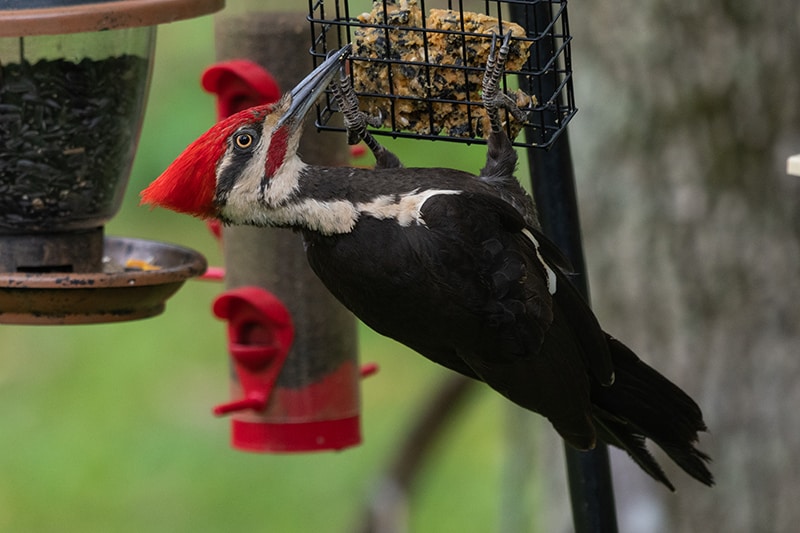
Also, isn’t it interesting how the Pileated Woodpecker chose the feeder placed highest first?
Coincidence or not, it’s something to take note of.
A Special Note on Nectar and Fruit Feeders
For hummingbird and fruit feeders you’ll want to protect them from wind tipping. Sugar solution may spill from an unsteady feeder.
Provide the feeders with shade during sunny days to prevent the sugar solution from spoiling quickly.
If you’re not one to quickly clean a hummingbird feeder, consider instead providing red flowers, especially tall bee balm ones.
Don’t Forget To Water The Birds
Mom was right: Don’t forget to water the flowers. If you were lucky, she also reminded you to water the birds.
You don’t want to lose your feathered Goldfinch friends to your fellow birder and neighbor Robyn because you forgot to provide fresh water.
Birds are attracted to the sight and sound of water, and they get most of what they need from rainwater and dew.
You can attract more birds and keep them coming back to your yard by positioning a water source like a birdbath or water feature where the birds can see it.
The best location for a birdbath should provide shade and a clear line of sight around the entire bath.
The shade will help avoid water evaporation and the 360-degree space provides a sense of security for the birds.