
Last updated on May 28th, 2023 at 09:57 am
Seagulls are common in the United States, but they have legal protections since they are migratory birds.
Seagulls are protected birds under the Migratory Bird Treaty Act of 1918. It’s illegal to harm, kill, capture, trade, sell, or transport them, even their nests or eggs in the United States, Canada, Mexico, Japan, or Russia. The purpose of this act is to protect birds from extinction.
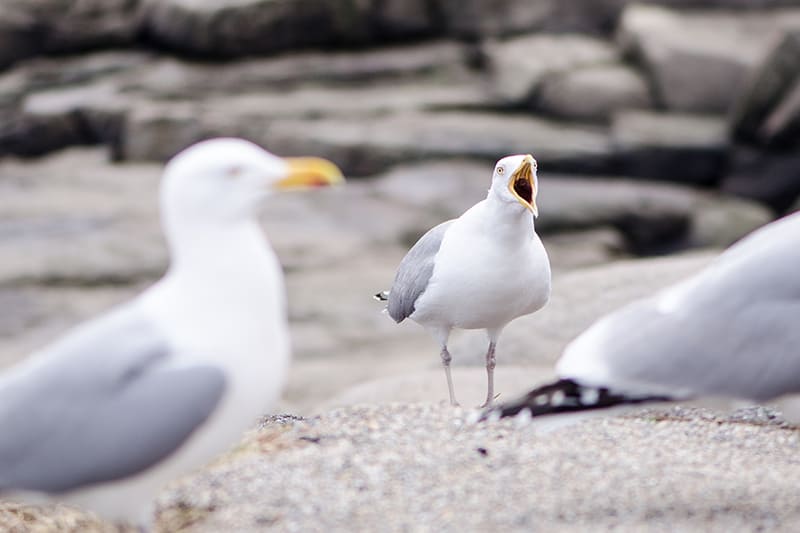
Seagulls Are Protected By The Migratory Bird Treaty Act
The Migratory Bird Treaty Act of 1918 is an international treaty between the United States, Canada, Mexico, Japan, and Russia.
It states that any hurting, capturing, trading, selling, or transporting protected species is illegal unless authorized by the U.S. Fish and Wildlife Service.
The act was first passed between the United States and Canada, and then it later extended to include Mexico, Japan, and Russia.
Seagulls are protected birds because they’re native and migratory according to the stipulations of this treaty.
Purpose of the Migratory Bird Treaty Act
The Migratory Bird Treaty Act aims to coordinate conservation efforts between countries for birds whose range spans multiple countries.
Together, participating countries have saved millions of birds by protecting their breeding grounds, wintering ranges, and everything in between.
Birds Protected By The Migratory Bird Treaty Act
Protected species include any migratory birds native to the United States.
These include birds such as the Akikiki, Apapane, Bushtit, Albatross (Black-browed, Black-footed, and others), Becard (Gray-collared and Rose-throated), Mallard, and Redhead.
Below is a list of other protected birds:
- Blackbird (Brewer’s, Red-winged, and others)
- Bluebird (Eastern, Mountain, and Western)
- Booby (Blue-footed, Abbott’s, and others)
- Bunting (Blue, Gray, Indigo, and others)
- Catbird (Black and Gray)
- Cormorant (Brandt’s, Double-crested, and others)
- Crake (Corn, Paint-billed, and others)
- Crow (American, Fish, Hawaiian, and others)
- Dove (Common Ground, Inca, Mourning, and others)
- Duck (American Black, Eastern Spot-billed, and others)
- Eagle (Golden, Bald, White-tailed)
- Falcon (Peregrine, Prairie, and others)
- Finch (House, Purple, and others)
- Flycatcher (Dusky, Gray, and others)
- Gnatcatcher (Black-capped, Blue-Gray, California, Black-tailed)
- Goldfinch (American, Lawrence’s, Lesser)
- Goose (Canada, Cackling, and others)
- Gull (Belcher’s, Gray-hooded, and others)
- Hawk (Broad-winged, Harris’s, and others)
- Heron (Gray, Great Blue, and others)
- Hummingbird (Bumblebee, Ruby-throated, and others)
- Jay (Blue, Brown, Green, and others)
- Kingfisher (Guam, Belted, and others)
- Loon (Arctic, Red-throated, and others)
- Mockingbird (Bahama, Blue, and Northern)
- Nightjar (Buff-collared, Gray, and others)
- Nuthatch (Brown-headed, Pygmy, and others)
- Oriole (Altamira, Audubon’s, Baltimore, and others)
- Owl (Barn, Barred, Boreal, and others)
- Palila
- Pigeon (Band-tailed, Plain, and others)
- Poorwill
- Quail-Dove (Bridled, Key West, and Ruddy)
- Raven (Chihuahuan and Common)
- Robin (American, European, Rufous-backed, and others)
- Sandpiper (Baird’s, Broad-billed, and others)
- Screech-Owl (Eastern, Puerto Rican, and others)
- Seedeater
- Sora
- Stork
- Swallow (Mangrove, Tree, and others)
- Tanager (Flame-colored, Scarlet, and others)
- Titmouse (Black-crested, Bridled, and others)
- Verdin
- Vulture (Black and Turkey)
- Warbler (Adelaide’s, Bachman’s, Bay-breasted)
- Whip-poor-will (Eastern and Mexican)
- Willet
- Woodpecker (Red-headed, Red-bellied, and others)
- Yellowthroat (Common and Gray-crowned)
Note that this list does not include all protected species. For the full list, see Title 50 Part 10.13 of the Code of Federal Regulations.
Penalties for Violation of the Migratory Bird Treaty Act
Breaking the Migratory Bird Treaty Act is a federal misdemeanor that can result in fines up to $15,000 and imprisonment up to six months.
It is also a felony to take a protected bird to sell it, with an additional maximum fine of $2,000 and up to one year of prison time.
Exceptions Allowed for Population Control Reasons
When birds threaten the health and well-being of human populations, the U.S. government offers an exception to the Migratory Bird Treaty Act to allow for population control.
For example, the U.S. government has allowed seagulls to be killed at Puget Sound ferry terminals due to complaints of aggressive birds and bird-dropping-related illnesses.
In some cases, the federal government allows hunting of protected species so long as the population is large and healthy enough to handle the decrease in numbers.
Accidental taking or killing protected species is also allowed in some cases, although not without dispute from conservation organizations.
Are Seagulls Endangered?
Some species of gulls are endangered, such as the Black-billed Gull.
The Olrog’s Gull and Lava Gull are considered vulnerable. The Adouin’s Gull and Ivory Gull are near threatened according to the IUCN Red List of Threatened Species.
Other endangered birds listed by the IUCN are:
- Relict Gull: Vulnerable
- Chinese Black-headed Gull: Vulnerable
- Heermann’s Gull: Near Threatened
- White-eyed Gull: Near Threatened
The IUCN Red List
The IUCN Red List was created by the International Union for Conservation of Nature in 1964 to track the global conservation status of animals, plants, and fungi.
The group assigns a conservation status to each species based on its risk of extinction. Below are the categories of conservation status:
- Not Evaluated: species that is not one of the 134,425 assessed species
- Data Deficient: species without adequate documentation of population health
- Least Concern: species that have been evaluated and do not fit into any other categories
- Near Threatened: species that are likely to become threatened in the near future
- Vulnerable: species at high risk of extinction in the wild
- Endangered: species at very high risk of extinction in the wild
- Critically Endangered: species at extremely high risk of extinction in the wild
- Extinct in the Wild: species only exist in captivity
- Extinct: no living members of the species
What Conservation Efforts Are Taken for Seagulls?
Conservation efforts taken for seagulls include protecting their breeding grounds and avoiding urban development near their nesting grounds.
Since seagulls nest and breed in coastal regions, they have become increasingly fragile.
Seagulls have also seen population rise in response to commercial fishing operations.
Discards from fishing boats are a great food source for gulls, although, to date, they have not been intentionally used as a way to conserve seagull populations.
Similarly, gulls do well when we include biodegradable waste in landfills.
But the negative impacts of including biodegradable resources in landfills have so far outweighed any conservation benefits.
In general, seagulls are more likely to be seen as a disruption of peace than a species that needs protection.
There have even been studies revealing how gulls observe humans and their eating habits.
Therefore, there are few ongoing conservation efforts aimed at protecting these species.
However, these species are a valuable part of our ecosystems.